About graceful dancers – Part 1: the Girls

The last sentence I wrote in the Quote of Alina Cojocaru, a few days ago, kept ringing on my own head:  “And she is so graceful!”. Some months ago I also wrote about this quality of Ivan Vasiliev’s dancing that can only be called manly gracefulness, as I don’t know any other word that fits. Why did I see the need to state it? Are not all dancers graceful?  Yes, they are… but I meant it in a very specific, not self-evident,  sense of my own.  What I had in mind was:  they move with natural, seemingly effortless, maybe even unconscious, perfect grace.
large

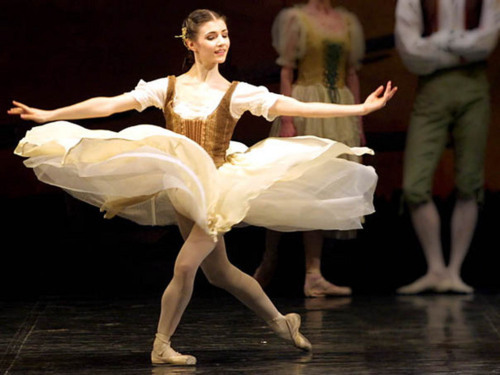
Alina Cojocaru in Giselle Act 1
with Manuel Legris

Some dancers seem to have studied for a long time how to make their movements the most beautiful … and some seem to just BE beautiful moving.  I don’t know exactly WHAT the difference is, but I get it after the first minutes of watching anyone dance. How I perceive it still eludes me. It’s not in the beauty itself, as I’m talking about a group where all are outstanding,  but about the kind of beauty, and how it is achieved. Some have this more fluid, free, almost instinctive quality to their movements – graceful movements  seem to spring out of them  as natural as breathing, and are lovely exactly because of that. Other dancers move so carefully, I sense – somehow – there are endless hours of rehearsal behind every port-de-bras.

I realize it does not make sense, since ALL dancers have this love/hate relationship with the studio’s mirror, the severe critic with whom they spend most of their time, and most respect! But still… it’s as if some dancers don’t worry, or forget the mirror when they are on stage, and just… dance!  They LET themselves dance, while others deliberatedly, self-consciously, MAKE their bodies dance.

—– A metaphore: it’s like the difference between an artificial, perfectly formed flower, and a real flower, where life’s miracle expresses itself in texture, fragrance, shades of colour, singularity. It’s a matter of taste: some prefer the silken man-made perfection, I prefer vitality and natural beauty. —

To me as audience, it makes a great difference. The careful dancers don’t seem at ease, and don’t let ME be at ease. I see – somehow – their great effort to create beauty, and then I cannot forget myself into their dancing, it makes magic more difficult to happpen: they push me into a role of my own, I am the Mirror now…

Some people are just born that way, I mean common people, not just professional dancers: they are graceful  sitting, laughing, talking on the phone, running, whatever. I suppose all dancers have this inborn grace – or they wouldn’t be dancers, would they?  Why , then, the painstakingly worry about the ideal form? Maybe they don’t trust their own grace? or their training/coaching damped it down, so they could achieve a certain aesthetic? I mistrust Vaganova, the Royal Ballet, ABT, for example, too much dancers there are… so careful!

So I have this unanswered question: are only my graceful ones born dancers, or what I see is the consequence of hiding natural beauty under an artificial, carefully construed one?  I don’t know.
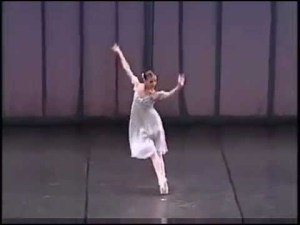
hqdefault
Alina Cojocaru in Giselle – click to link
alina
Alina Cojocaru in Sleeping Beauty – click to link
1fujbunlonlik
Uliana Lopatkina in Carmen – click to link

Examples!

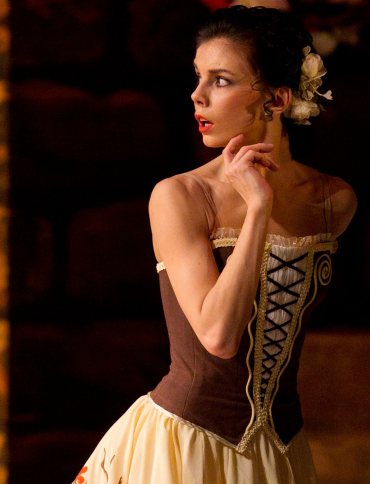
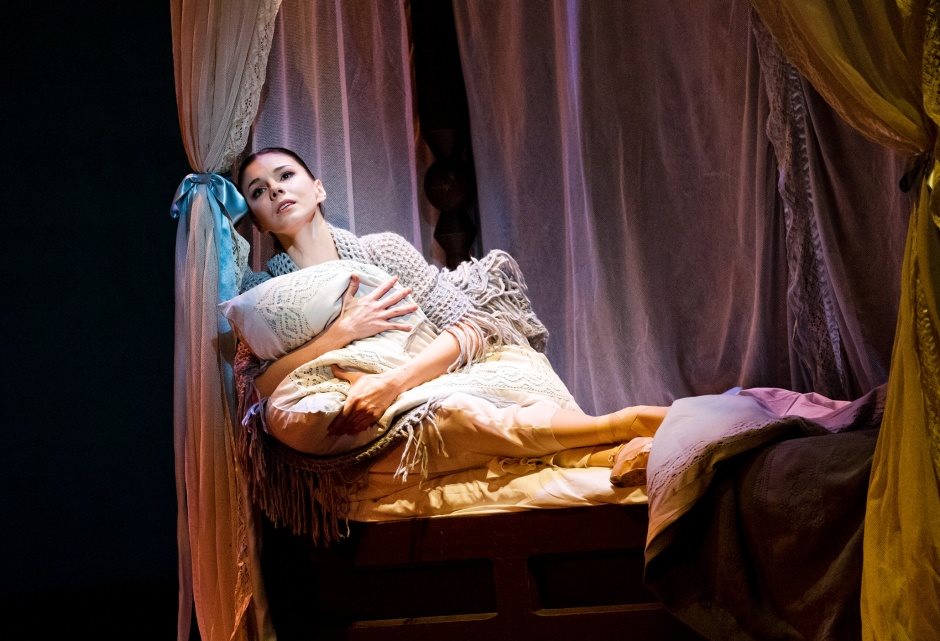
Alina Cojocaru is Grace itself wearing point-shoes. I could watch her endlessly. There are two more links on her, chosen at random.  Compare with other famous dancers and you will see what I mean (I hope).

Alonso’s Carmen is a ballet I had a hard time liking, it’s so odd – but Uliana Lopatkina made me love it, she seems to be enjoying the dancing, and her Carmen to be having fun with her seduction games – a wellcomed change to other Carmens, that stretched way too far the seductress choreography. Her Nikiya is also lovely, as is Lucia Lacarra’s. Compare!

Marcia Haydée in anything she choosed to dance was enchanting… Not an all-encompassing list, but anyway the graceful ones are rare nowadays!

Natalia Osipova is a special case: she is THE most self-conscious one,  but adds such a lot of  (also very careful) acting to it, that it compensates, to a great extent – and most of the times – for her visible effort to create perfect moving Beauty, It’s a successful effort – but it must take enormous amounts of work, and of energy while performing, to get it all done at once. I wonder… if she would just let herself go at some point, and recklessly forget anything but the joy of dancing…

Natalia-Osipova-Firebird
Natalia Osipova in Firebird

Quote of the day – Alina Cojocaru

In an interview when she was still principal of Royal Ballet, in August 2012:

jr_fille_cojocaru_close_012_500“I try to go on stage and be honest with myself. I can only rely on my feelings. My main aim is to share what I feel with my audience. When I go on stage I forgive myself if my show’s not perfect, but I don’t forgive myself if I did not become who I should be on stage. (…)
What I love about working in Hamburg is the creative environment. Even working on ballets that have been created so many years ago, you can bring something to it, and feel like you’re still part of it, bringing ideas to the ballet. That’s nowhere to be found in London of course. You have the people in charge of the ballet trying to protect the choreography… protecting it to keep it looking like it used to be. I do respect the choreographers [but] it’s a constant battle there to bring something to every ballet I perform, to bring something new into the old.”

…but then Neumeier created Liliom for her in Hamburg, she won the Benois Prize on it, and moved on to Tamara Rojo’s now revolutionary ENB. Our luck! When she is on stage, her deeds speak for themselves  – she IS what she says! Admirable dancer… AND person!

—————————————————-

A battle to bring something new, of her own, to a ballet?  Indeed!

What are they so afraid of, there in Royal Ballet? Protecting choreography is more important than “ME”, in the audience? Odd way of thinking – choreographies are already very well recorded, that should be enough!

How nice there is ENB now, where I’m taken into account… I don’t have any doubts where I will chose to be in my ballet evenings – there where Tamara Rojo and Alina Cojocaru will be giving us new choreographers, new ballets, new, individual, ways of performing the worn out old roles! 

The bows of Kristina Kretova and Ivan Vasiliev

http://youtu.be/GKWYk90wUh4

———————————————

I love the way Kristina Kretova and Ivan Vasiliev show they are happy with their performance – and happy that the audience had a great time watching it. They, specially Ivan Vasiliev, are so at ease, the “fourth curtain” has thinned down to almost nothing, and the audience must feel as if some of the glow is being handed down to them… a very good feeling!

There is a nice cumplicity there, a shared love for Dance, a shared joy about the magic that was created on stage. I love that about russian people – about russian audience – the warm, open way they react. And the way Ivan openly shows THEY make him happy… A win-win trade, or a fair love affair, if you like it better!…

It makes ME happy to see.  Even me, who was not there!

Music begging for Dance

There was a time in my life when I had pushed Dance to the darkest, furthest possible corner in my mind, where it stayed for a long time. During that time I also slowly ceased to listen to music. It was not a coincidence. I cannot listen to music and not see dance. They are two sides of a coin, one does not exist without the other.

DancexMusicThere is music that literally BEGS for dance, is there not?  When I was young, I would comply, and dance around the house while doing every kind of everyday chores, my dogs going crazy, “dancing” too, the cats flying in terror to hide under the bed.

But worse, as my nearest neighbours lived far away, late at night I would turn volume on highest, and dance outside, on the paved terrasse or on wet grass, around flowerbeds, being “lifted” by trees, in and out the house, drunken with music and movement. I must have been quite a sight during these endorphine highs, kkkkkk… Gratefully, I doubt anyone ever saw me, it was just the music and me, in an empty magic world. How absurdely – and happily – romantic we can be when we are very young, and life has not yet cooled us down!

But, about music that begs for dance: some are so “danceable” in my mind’s stage, and so rarely used by choreographers! Saint-Saëns and Dvorak, for example. Smaller, romantic pieces of both composers are very popular in end-of-term ballet school performances, but important choreographers insist in not using their greater works (Sigh…). They are underused and worse, mostly misused!, even if there are a few exceptions: Ratmansky choreographed Saint-Saëns’ Introduccion et Rondó Cappricioso (at last!) for ABT’s Ballet School – even if it’s a children ballet -; Roland Petit used Adaggio from the  Organ Symphony in Les Intermittances du Coeur (La Prisonnére, one of the most beautiful PDDs ever!);  Neumeier’s Spring and Fall is on Serenate for Strings by Dvorak – but that pretty much sums it up.

Link to La Prisionnere: http://youtu.be/wOgELwqeyMU

Saint-Saëns 5th piano concert is awesome, I’m passionate about it. You already knew it? So just listen again…: <http://youtu.be/1IEYtta_ZsI >

Then there are composers that are known because of a few popular works, and have a wealth of other stunning or delightful pieces that would make great ballets, like Grieg, Rossini,  Berlioz, Debussy, Bruckner, the list is HUGE. I wonder why modern choreographers keep “remaking” old ballets with scores that did not, at any time, “fit” the plot, like Giselle (a lively music to a dramatic context in 2nd act, it’s so ODD…) . Have you listen to a Bruch Symphony? To Rossini’s Quartets for Strings? To Respighi’s Ancient Airs and Dances? They make you dance, either you want it or not!

YouTube made it possible, also, for me to become acquainted to almost unknown composers (My Pleasure, Sirs!). My latest passion is Mieczyslaw Karlowicz.  Link:  <http://youtu.be/LDeols0tIzs>

I must make some clip using his Rebirth Symphony, this is lately my way to render homage to my favourites. A very skewed way, I know, since I must use dance created on other scores…  But there are others that, I believe, feel the same as I do – this link is to a video where  someone synchronized excerpts of Coppelia and one of Balanchine’s Waltzes with music by Dvorak. It’s a curiosity: synchronization is perfect, and at least it shows how Dvorak is “good dancing”!

Link: http://youtu.be/wOgELwqeyMU

By the way, I still wait for the definitive choreography to some scores: L’Aprés-midi d’un Faune is one of them – although I like the art-deco visual style of the original version, it is not what I “see” when I listen, and later versions are mostly… weird! Suite Maskerade by Khatchaturian is another one (also misused, some choreographic versions should have been, I don’t know, …censored? barely able to be called dance! I refuse to include their links…)

I uploaded one of my favourites “that dance”, it is a rare recording of music by AstorPiazzolla, in a live performance in my town Porto Alegre, Brazil (where the Devil lost his boots – once in while SOMETHING worthwile happens here, and this one! I wasn’t believing my own ears!!!).

LISTEN  to it, it’s amazing! Link: < http://youtu.be/Y9QccmUvxvY>

Quote of the day – Francis Patrelle

” CLASSICAL  DANCE  IS  SO  UNFORGIVING . ”

————————————————————————————————–

I found this  quote as single sentence, out of context. It started so much associations in my mind that I decided not to search for the context, but let it stand there in all it’s shortness and possible meanings.

Ivan Vasiliev’s arms – Once more.

If you do not know russian, you are bound to find this kind of treasure, just by chance, from time to time: Kings of the Dance 2010, I think, but performed in 2011? Christopher Wheeldon’s “For 4” danced by David Hallberg, Joaquin de Luz, Nikolay Tsiskaridze and brand-new king Ivan Vasiliev.

Great, amazing dancers, all of them, and it was fun trying to catch all the differences between schools, training and styles – they have each their own way to perform the exact same step, and even a different way to feel/obey/use the music!! Mighty interesting!

But do you know what I liked most of all? Once more? Ivan Vasiliev’s arms!
“For 4” shows his “arm work” at its best. I like his arms because: a) they are able to create such smooth, continuous, perfect lines, from neck to finger-tip, and b) they move, they dance too. They are not just there, parked in the right position, were you expect they should be if the dancer knows his thing – they dance too, along with legs, head, and what else he is using, all together creating a seamless, single, complete movement.

Snapshot - 43
For 4 – Ivan Vasiliev’s beautiful arm lines

I tried to capture snapshots, but they all became fuzzy: his arms never freeze in “becoming positions”, they are never still – they are taken toward that instant that defines/finishes a move, then, for just a fleeting, beautiful moment, they are THERE, and already they are changing again, and again, and again, as much as legs flow through positions and steps.

If you choose low speed to watch the video on this link, you will see what I mean. Watch closely the first minute, and then from 4:59 on for some minutes.

http://youtu.be/TGJ4mL6eoso

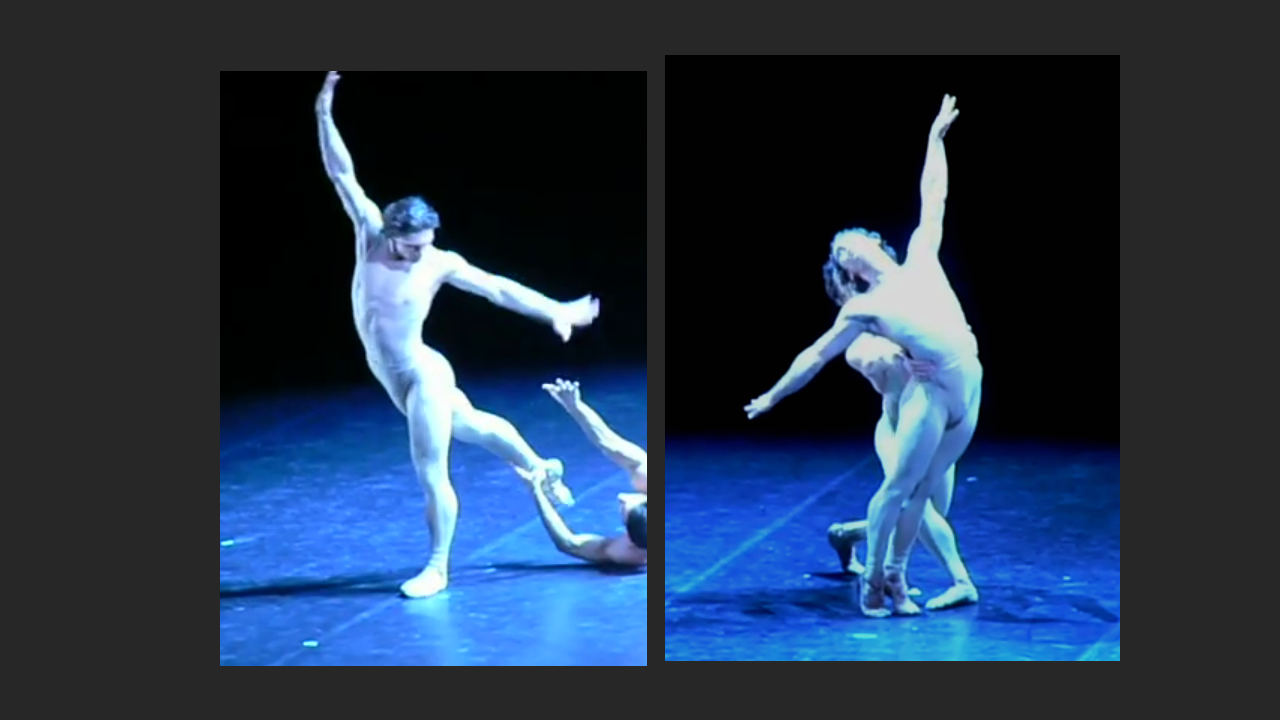
Labyrinth of Solitude is also a wealth of beautiful lines, I didn’t know how to choose, I just picked some at random.

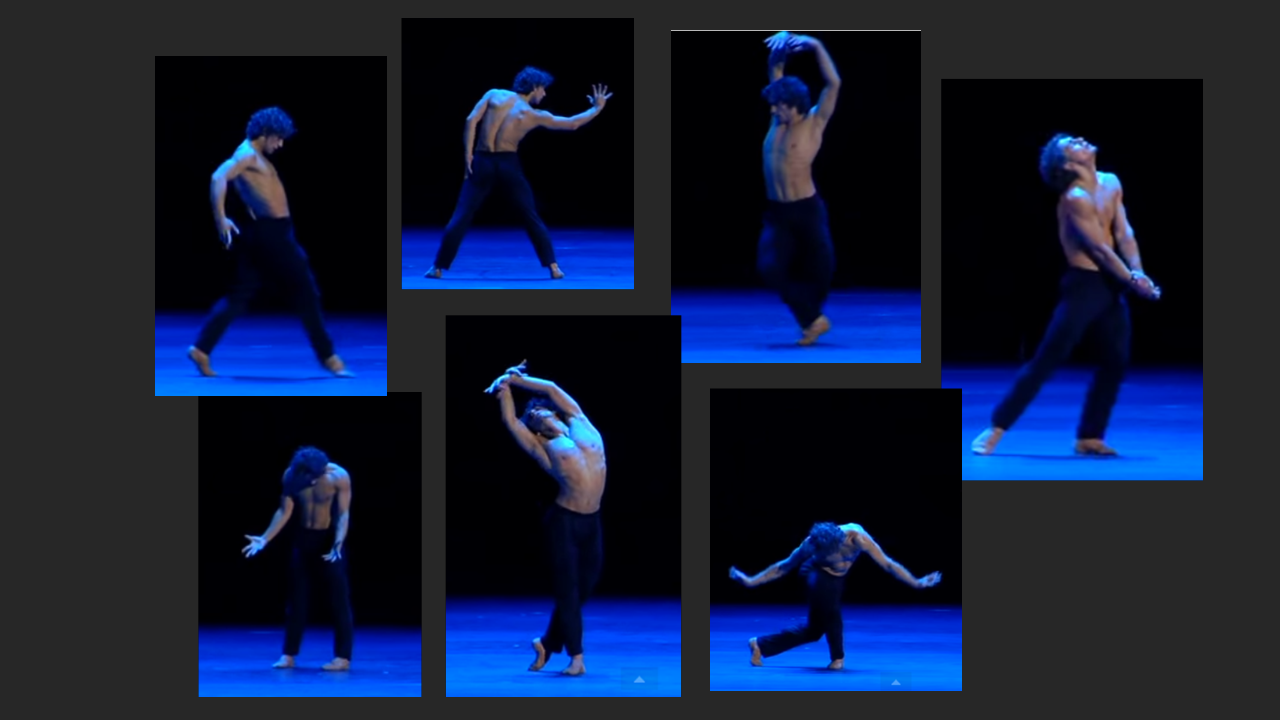
Labyrinth of Solitude

As I said elsewhere, many a “swan” could learn from his wings in Blue Bird and Le Combat des Anges – he moves his arms as real birds (or imagined angels) do: in long, slightly curved, smooth, smoooooooth lines that start in the upper-arm, never in the hand, wrist or ellbow. They make me want to fly, as if I had a memory of been airborne before.

Blue Bird
Blue Bird

Snapshot - 38

Le Combat des Anges
Le Combat des Anges

Snapshot - 35

Am I the only one who sees so much beauty in his arm movements? I never read any other comment about them, although they constantly attract my attention! It makes me feel weird, as if I’m seeing “things”, or as if I’m the only one who can raise her eyes above his legs…  kkkkk! It may be a matter of taste, of course, my opinion just a strange one in a Tower of Bable of different ways to judge Dance…

Quote of the day – Tennessee Williams

“Then what is good? The obsessive interest in human affairs, plus a certain amount of compassion and moral conviction, that first made the experience of living something that must be translated into pigment or music or bodily movement or poetry or prose or anything that’s dynamic and expressive – that’s what’s good for you if you’re at all serious in your aims.”

——————————-

marlon-brando-vivien-leigh-21607
Vivien Leigh and Marlon Brando. Don’t they seem to be dancing?

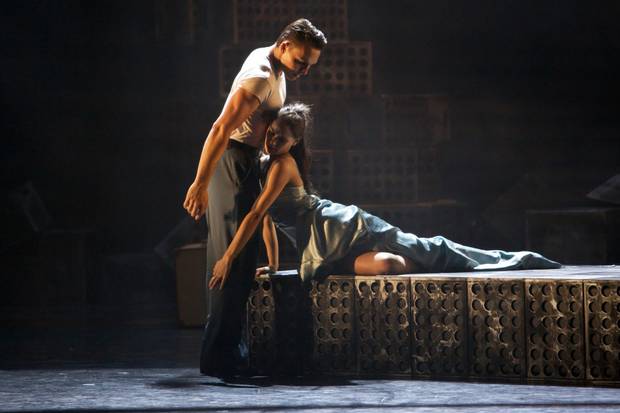
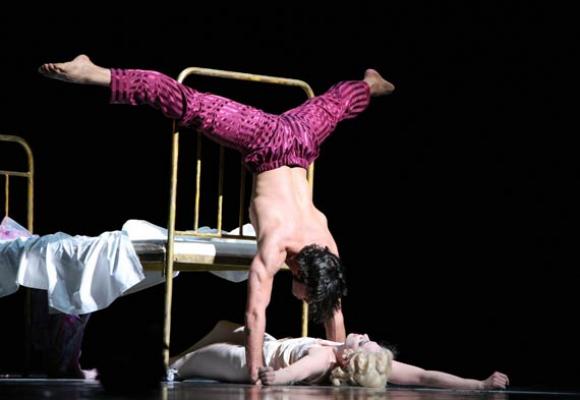
One of Tennessee Williams’ most powerful plays, A Streetcar Named Desire (1947), became a movie (directed by Elia Kazan) that earned various Oscars at the time – a raw, heart-wrenching and desillusioned affair… and an absolute must-see!


Scottish Ballet
Scottish Ballet

Two choreographers did a great job translating   it to dance: Neumeier for Marcia Haydée and Stuttgart Ballet, in 1983, and Annabelle Lopez Ochoa, working together with movie director Nancy Meckler, for Scottish  Ballet (2012).


Stuttgart Ballet
Stuttgart Ballet

Neumeier play is in Stuttgart’s regular repertoire (scheduled next in May, 2015), and an item in my wish-list!


There was some dismissive nose-wrinkling, once more, on these kind of story-telling ballets, “a lesser kind of dance art”… If Tennessee Williams’ were to write a play equivalent to  a ballet without narrative, it would be made of meaningless sequences of beautiful words… and THIS should be some kind of “higher art”?  Oh, spare me!

Natalia Osipova’s Awards – Is anyone surprised?

329156_226067570807890_455786005_o
I’m just as big a fan of Natalia Osipova as of Ivan Vasiliev. And there are others, I just had not time, yet, to write about them all (when I started this blog I had a latent demand of issues I HAD to write about, but now I’m good, I think…).
Natalia is an absolute pleasure to watch. I had no doubt, at any time, that hers would be a brilliant path, she will become a legend.
I remember only too well that when she became a Royal Ballet principal, a lot was said about her lack of clean technique, of excessive energy, of too russian style – the same kind of remark made all the time about Ivan Vasiliev. What will these critics say now? That she didn’t deserve the awards? That we may love her performances, but should not, because they know better?
Ok…

It is nice to see things be shaken a bit there, she brought new spark and life into Royal Ballet’s roles. She’s not a dare-devil as Ivan Vasiliev, has not all his revolutionary potential, or better said, she HAS, but chose not to use it. She chose, instead, a structured, safe environment, probably it suited better her workaholic, perfectionist temperament. She was right, obviously – there are the results!
I was disappointed when she joined Royal Ballet, and when she almost disowned her contemporary experience in Solo For Two. I do not mourn Vasipova as some do (I believe a great dancer brings the best out of any partner, and in that sense, they being apart does a lot of good to other dancers). But she chose the safest path of all… (sigh). A loss for the changing process that is happening in Dance, but if she is happy (I hope she is…), and if she feels it enables her to get the most out of her talent, so be it! We surely cannot complain!!!

I wonder if there will come a time when, coaching a soloist in a new role, it will be “no, no, look, that’s how Osipova did it!” instead of “that’s how Dame Fonteyn did it”. I loved Dame Fonteyn in my (her) time, as we all did, and I still love her10408107_1548177652131962_1708838414395946022_n. But I must be candid: now I love Natalia Osipova more, she is a more complete artist. Margot Fonteyn WAS the best, really was, but… Dance is changing, and for the better. Criteria that applied 50 years ago, and were absolutely right at the time, are not valid anymore.

So they are “hot” ballet dancers. Good!

IV&MV

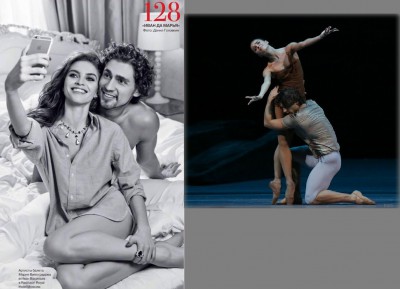
I liked this article in Tatler (RU), with lots of beautiful photos that associate ballet in people’s minds with young, sexy and fashionable dancers. Excellent!

So they are “hot”, a charming couple that young people can identify themselves with, as they do with sport, music, movie stars – why not ballet stars? People under 35 that do not dance are underrepresented in ballet audiences, I bet because of ballet’s old-fashioned image. But even ballet is changing, so let them be lured in any way to a ballet evening – let them see Ivan Vasiliev dance just once…

I’m sorry for all defenders of ballet’s outworldly purity, but we live in 2015

Link to the whole series of photos in Tatler:
https://www.facebook.com/media/set/?set=a.757982010946729.1073742058.116589208419349&type=1