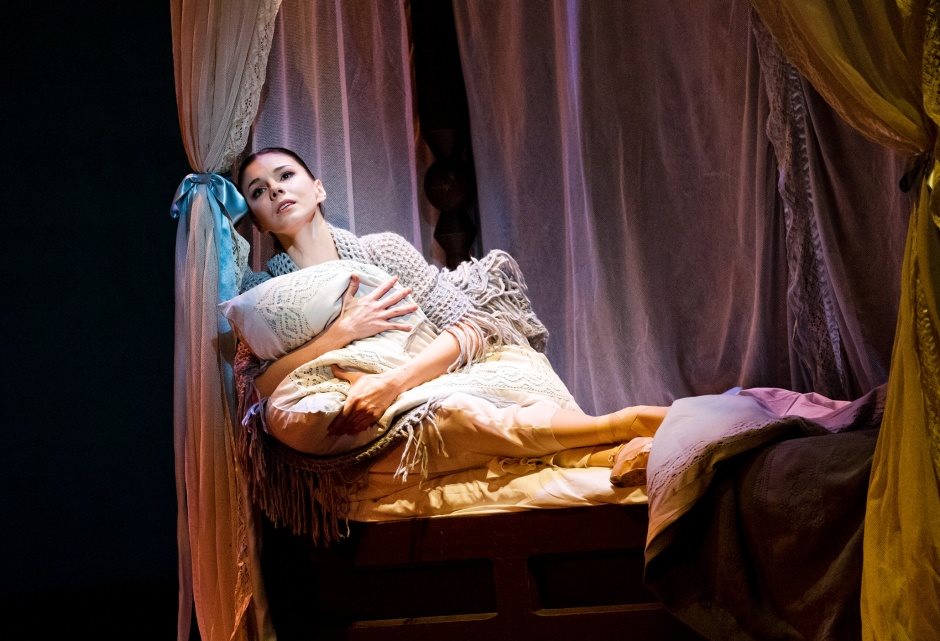
Natalia Osipova’s Awards – Is anyone surprised?

329156_226067570807890_455786005_o
I’m just as big a fan of Natalia Osipova as of Ivan Vasiliev. And there are others, I just had not time, yet, to write about them all (when I started this blog I had a latent demand of issues I HAD to write about, but now I’m good, I think…).
Natalia is an absolute pleasure to watch. I had no doubt, at any time, that hers would be a brilliant path, she will become a legend.
I remember only too well that when she became a Royal Ballet principal, a lot was said about her lack of clean technique, of excessive energy, of too russian style – the same kind of remark made all the time about Ivan Vasiliev. What will these critics say now? That she didn’t deserve the awards? That we may love her performances, but should not, because they know better?
Ok…

It is nice to see things be shaken a bit there, she brought new spark and life into Royal Ballet’s roles. She’s not a dare-devil as Ivan Vasiliev, has not all his revolutionary potential, or better said, she HAS, but chose not to use it. She chose, instead, a structured, safe environment, probably it suited better her workaholic, perfectionist temperament. She was right, obviously – there are the results!
I was disappointed when she joined Royal Ballet, and when she almost disowned her contemporary experience in Solo For Two. I do not mourn Vasipova as some do (I believe a great dancer brings the best out of any partner, and in that sense, they being apart does a lot of good to other dancers). But she chose the safest path of all… (sigh). A loss for the changing process that is happening in Dance, but if she is happy (I hope she is…), and if she feels it enables her to get the most out of her talent, so be it! We surely cannot complain!!!

I wonder if there will come a time when, coaching a soloist in a new role, it will be “no, no, look, that’s how Osipova did it!” instead of “that’s how Dame Fonteyn did it”. I loved Dame Fonteyn in my (her) time, as we all did, and I still love her10408107_1548177652131962_1708838414395946022_n. But I must be candid: now I love Natalia Osipova more, she is a more complete artist. Margot Fonteyn WAS the best, really was, but… Dance is changing, and for the better. Criteria that applied 50 years ago, and were absolutely right at the time, are not valid anymore.

So they are “hot” ballet dancers. Good!

IV&MV

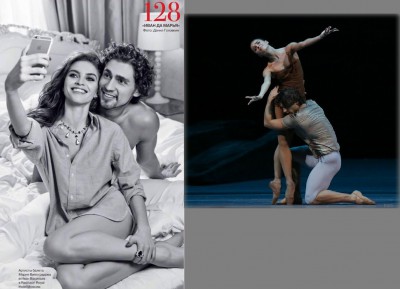
I liked this article in Tatler (RU), with lots of beautiful photos that associate ballet in people’s minds with young, sexy and fashionable dancers. Excellent!

So they are “hot”, a charming couple that young people can identify themselves with, as they do with sport, music, movie stars – why not ballet stars? People under 35 that do not dance are underrepresented in ballet audiences, I bet because of ballet’s old-fashioned image. But even ballet is changing, so let them be lured in any way to a ballet evening – let them see Ivan Vasiliev dance just once…

I’m sorry for all defenders of ballet’s outworldly purity, but we live in 2015

Link to the whole series of photos in Tatler:
https://www.facebook.com/media/set/?set=a.757982010946729.1073742058.116589208419349&type=1

DANCE – KNOW THY AUDIENCE!

For some time now I have been wondering, and making comments, on the audience of Dance. I believe that the performance of ballet professionals and the big companies’ stagings were more foccused on pleasing dance experts and the conservative part of the audience, neglecting a wider one that could and would enjoy Dance, and ballet, it just some changes were made…This was more a feeling that a certainty, and of course I could be wrong.

But I have found a survey about audience made in 2010, in USA, comissioned by Dance/Usa , a national service  organization for the professional dance field, within the scope of one of their initiatives: EDA – Engaging Dance Audiences. The survey was made by WolfBrown, a specialized agency that provides ” qualitative and quantitative market research services to a wide range of cultural organizations.” In total, 7,454 dance patrons completed the survey.

*****6 out of 10 in the audience are dance professionals or ex-professionals

Now look at that:
“A quarter of all dance buyers take dance lessons or classes at least occasionally, and another 33% used to, earlier in their lives.” That’s 58% of the audience, or 6 out of every 10!”

WolfBrown sorted the audience, however, by another criteria:

– Active or Serious Dancers are people who regularly take dance lessons, perform in front of live audiences or choreograph. They constitute 2 out of every 10 buyers. I suppose this means: they are either active dance professionals or actively training to become professionals.

– Social Dancers are people who dance socially, either regularly or occasionally, but who are not “Active or Serious Dancers.” They constitute 38% ot the audience – this means 4 out of 10, and among these, 3 are ex-dancers.

– Non-Dancers are all those not included above. They constitute just 43% of ticket buyers!

Dance AudienceIn the report, there is this cautious remark beside this graph:

“– In other studies, we have observed the presence of artists in the audience, but not to this extent. The larger point here is one about the inter-dependence of different players in the dance ecology.”

************************************ I want an inspiring, uplifting experience

DanceAudience Motivation

“To experience the kind of magic only Dance can create” is not an item in their list… No wonder, as my clumsy, unprecise concept of “magic” means the kind of experience you have when exposed to Art: an experience that may be anywhere from the most subtle, unconscious to the most overwhelming one, but always touching  deep existential strings. Note that “to have an intense emotional experience” is low on that table, while “to be inspired and upflifted” is at the top. I imagine that respondents, like me, regarded the top one as a life-changing experience, and the  “intense emotional experience” as any kind of “emotional”, including the  predictable, shallow kind that newspapers and trash-talk-shows use “ad nauseam” to increase their sales. So I chose the top one as the closest, in fact as a synonime to my “magic”, and hope I’m not pushing it too far – because “magic” in the top position agrees with all I believe in!

The report states that to Active or Serious Dancers  the most important motives are:  to engage intellectually with the dance or choreography / to energize your own creativity / to see great works by the masters / to discover new choreographers and companies. This is a   pragmatic group, they want to enhance their skill and specific knowledge.

It follows that  “To be inspired and uplifted”  stands  on the top of the list because the Social Dancers and Non-Dancers want it,  it’s THEIR principal reason. If no real “magic”, nothing really special is created,  it will be a disappointing experience to THEM.

The performers on stage know that their peers are a large part of audience (roughly 60%) – with their keen, knowing  eyes hefted on the smallest movement, possibly looking for faults! I wouldn’t be surprised  if the wish to concquer their respect and praise became stronger than anything else….

That’s why I love performers who are more foccused on creating magic than in showing off their excellent technique. Remember: the most important motivation to see any kind of production, to a large part of the CURRENT audience, is the wish “to live an inspiring experience” – it probably is also the motivation that can win more “outsiders” over.

************************************Yes, I’m willing to see an unfamilar work

One last comment, now about constantly re-staging familiar works. Respondents were asked to agree or disagree with this statement: “I prefer to see familiar works that I know I will like rather than seeing unfamiliar or challenging work.”

And see! roughly 6 out of 10 disagreed! including Non-Dancers! If you take  10  Non-Dancers, then:
1 of them prefers a familiar work (only one!)
3 prefer new works
3 are willing to either kind AND
3 have mixed feelings about this (still hope on them!).

But there is an exception, and an expected one: when it comes to ballet productions, 45% prefer familiar works – the conservative traditional-ballet-loving audience I always talk about!

********************************************************* Young audience?

The survey also tried to find out about technology-based alternatives of watching a performance. All groups prefer live-performances (OF COURSE!, who wouldn’t?), so interest in technology-based viewing is not that big. Anyway, two conclusions stand out for me: the younger the audience, more interested in technology-based possibilities they are, not instead, but ALSO! A clear trend! The only exception is about sites with pay-per-view performances – these interest all ages and groups almost the same way.

(Don’t forget we are talking about audience with access to live-performances! What to say, then, about audience that has access to Dance ONLY through technology? Nobody remembers they exist, a “potential, still unexplored market”, in business wording…)

——————————————-

These results must be viewed cautiously, of course. WolfBrown analyzed north-american audiences, in other countries they may have a different behaviour, and great companies like NYCB and ABT did not adhere to the survey.  (If I were bold, I would bet that Non-Dancers are an even smaller part of the audience of the great companies…)  Even so, to me these ARE interesting results, in that they prove that my complaints are not without reason, and in that it is the only effort to analyze Dance Audience that I know of, so far.

Link to report: < www2.danceusa.org/uploads/EDA/EDA_NationalSurvey_Overview.pdf >

Quote of the Day – Daniel Nagrin

“They don’t want to deal with people. They want to deal with things. They want to deal with extensions and plies and beats and words that don’t have to mean anything. They’re not interested in people. They’re not interested in you. They don’t plumb your depths. In other words, they’re not humanists.They’re playing with things.  They make dance a thing.  A thing.”
(interview when he was 85 years old, talking about post-modernism in Dance, exemplified by Merce Cunningham’s style).

Danile Nagrin was an actor and a dancer, choreographer and teacher. He wrote, among other books “The Six Questions: Acting Technique For Dance Performance”. He was deeply influenced by Stanislavski’s Method, and a fierce humanist.

I’m a fan!!! And we have something in common… in the Introduction of The Six Questions he says: “I may believe fiercely, but I’m sure of nothing.” (italics are his)  If you read my ABOUT, you know that’s exactly how I feel.

Link to the interview is: <http://jashm.press.illinois.edu/12.3/12-3Interview_Roses-Therma114-119.pdf&gt;

The Swan Lake Ballet Turned Into Theater

I had radical positions about pure-classical-Ballet, but they just suffered a good shake!  As almost pure-form Dance, I dismissed the great classicals as unimportant in current days  (and lost some readers by doing that…). Vasiliev’s successful performance in Swan Lake, the way he interpreted his Siegfried, making people forget about ’emploi’ and Basilio/Philip and turning him into one of the best Siegfrieds ever, proved this blog’s point about the importance of Content in Dance. But he would not have danced Siegfried if Tamara Rojo had not invited him, and let him free him to act. In fact, I’m sure she invited him BECAUSE of that. Probably all Principals are allowed to act, there is even a real kiss (!!!) in last act, and Tamara Rojo herself was accused of a “too passionate” one on  her (Matthew Golding) Siegfried. She calmly answered:”“Well, I thought, after three hours on stage, I deserved it. Look at him. Who wouldn’t?” .(kkkkkk) Isn’t she great?

But she is a revolutionary AND wise: ENB retained all the classical form, with beautiful staging and competent dancing, but allowed acting TOO, and as a result the show is a huge succes!!  ENB showed ME that that the classicals CAN have content, if just someone is bold enough to make necessary changes (I thought no one was…)!

But I’m not satisfied…  ENB is an exception, not the rule. I suppose people are so used to the white ballets, and their lightly coloured companions, as they are, and they ARE so beatifull (I agree!), they cannot understand my prejudice, it sounds  as if I am not REALLY a ballet-lover… I was thinking: how could I show someone what bothers me? So I came up with this idea of comparing them with Theater somehow, and it ended up being a most amusing task. Please, if you love Swan Lake, don’t be mad at me, it’s just a joke!

—————————————–

(In a former post about Dance x Theater I reached the conclusion that between Dance and Theater there are just two major differences: the media – voice x body, words x movements -, and the range of ideas and emotions they can express, that is not fully coincident.)

THOUGHT EXPERIMENT: Swan Lake Ballet transformed into Theater ————

There are no complex emotions, no complex characters, no complex plot in SL, it is well within the coincident range of ideas and emotion both Theater and Dance can express, so this should not be an issue.

All we must do is change the media of Swan Lake from body to voice.

Ballet does not use voice/words, so, the other way round, we will not use body and movements in our Theater play.

The mime transposed to words:  very old-fashioned words, arranged in simple, few phrases, ponderously spoken, with lots of intonation, but almost telegraphic in their shortness. The words would have to be chosen with great care,  so each phrase carries the same amount of information of the corresponding mime.

The dancing sequences transposed to voice: a lot of sounds emitted in sequence, sounding gorgeous together, but without any meaning.

Acting during pure classical dancing is not required, or even disapproved, so the corresponding sounds should not express anything.  They could even become a song, but the song must be made in such a way as not to stir any feeling in the audience, except pure aesthetic admiration (if this is a feeling. Is it?).

If there is mime during dancing, corresponding words /phrases, of course, would be said in the right places during the sequences of meaningless sounds.

To make a fair transposition, actors would not be allowed to move at all, including facial expression, except they could smile to show how easy it is to make all difficult vocalizations (this kind of smile has nothing to do with the story, so it can stay).

As a whole, our play would be made out of short sequences of words/phrases, that would tell the story or inform what is going on, and long sequences of gorgeous meaningless sounds.

Light and settings could be the same, but we should add some seating arragements – it will be hard on our actors to stand still during the whole play, they better be seated. And then we would also want to change tutus to something more comfortable, now that they are sitting.  We design instead sparkling white garments with great, high, wing- like scarfs  that can flow constantly over the male actor´s face seated next by, to blind and/or hide him during his vocalizations, like tutus do in PDDs.

Done! Now we take seats in the audience and watch the play.

….

We bring Tchaikowsky’s music back, it is not usual on Theater, but we have to do something…

….

Although we  can see some very elegant, sophisticated people making positive comments about our break-through staging, most of the audience is yawning or shaking their heads, and they look definitely dismayed. WE are dismayed. It didn’t work.

THOUGHT EXPERIMENT 2 – A Swan Lake Theater Play, and back to Ballet——

We surrender. We need more to stage Swan Lake as  good Theater, the more so if we want it to be, not just good, but awesome (it should be easy, SL has great possibilities, it is all made of symbols and myths that permeate our culture).

So we forget, for the time being, all about Ballet, and give us freedom to use whatever resources there are in Theater to create a magical, impactful SL. Not being experts, we come up with just 1,859 (approximate number) ways to turn our play into really good Theater and  an unforgettable experience.  We design new, timeless settings and costumes (myths are timeless) – they become impressive, half gothic, half dream-like;  we write powerful dialogues;  we embed layers of meaning both in settings and written text and choose carefully our actors, capable of imparting deep, vital emotion – of course,  we bring body-language back, so they can use all their acting skills.

AHA, great success!!! Full houses, months on stage! We are very pleased with ourselves.

Now we realize we could make a transposition the other way round, back to Ballet! We have learned what works, it could probably enhance any Ballet performance too. We think about…

….

….

No, a total transposition would decharacterize SL in such a way, it would not be Ballet anymore.  We don’t want to make Ballet lovers unhappy, so maybe we use just some of the resources, in a way that will not shock them?

Let’s take the powerful text first. Text is choreography, we must change choreography. We try to create new movements, but are severely limited by Ballet canons; we sequence movements in new ways that are more meaningful, but there are just  that much movements available, and structures we cannot change, like the Grand PDD.  We try hard, but are unable to bring deep content to the 32 fouettés, for example. The outcome of our effort is almost none.

Well,  we can choose more expressive dancers, can we not? A new problem: after we select ballet dancers with the right body-types, among them those with the required technical level, and among them those with great acting skill, we are left with… none! So we change our selection criteria, and choose dancers that are great actors, and that’s it.

Next, we try our hand with body-language. In Theater play it was a decisive resource in imparting all that profound emotion, life and meaning – and this should be easy, as media in Ballet is the body. So we proceed to embed body-language into dancing.

…ooooohh…  we had forgotten! Using body-language in Ballet is met with great resistence: it is considered unrefined, incompatible with Ballet’s purity, to some it is even disturbing. And it would mar the perfection of the choreographed lines – without perfect lines, Ballet is not Ballet! We must give up. And fire our expressive dancers, they are all very popular, that means expensive,  and we cannot use their skills anyway…

As a last resource, we change settings and costumes to the new impressive ones – and are showered with complaints: ‘Ballet deserves a costly, sparkling, luxurious frame! How drab and cheap yours look! Where are all the pearls, stones, laces, plumes, bows, embroideries, flowers, frills, pleats, drapes, gold, silver, brocade, velvet, silk  that belong here? Where are all the plumed tutus, the capes, veils, hats, crowns, tiaras, wigs, fans, scarfs, gloves, brooches, pins, lockets, necklaces, sashes, boots and high-heels that make out of  SL such a great show?’

Ok, Ok, Ok! Out with them, then…

(looking at each other)…  (sighing)… (realizing a lot of disapproving looks all around us)… (looking at each other again)…

You know what? That’s it! Our notes into the waste-basket, and we go see Billy Elliott!

——————————————–

Jokes apart: I was wrong, I DID throw the baby away with the bath water.

There is much beauty in the classicals, and there are many ways to bring Content into them, so I should not dismiss them so easily.

I really believe that, if certain changes were made in the classical ballets, their worth would soar up, and they would enchant a wider audience that deserves to be there,  that wants to be there. Me, for example.

I’m sure a compromise between tradition and meaningful content is possible,  without loosing the essential beauty of the classicals. It is sad to let such emblematic works be a mere display of technique, beautiful lines and expensive golden glow. And remember, to the audience of non-experts,  there is not even  technique to be seen, except as quantities: height of a jump, number of turns, angle of an extension, they are unable to perceive all the fine details a professional can enjoy.

Some re-stagings introduced major changes, like Romeo and Juliet by Nacho Duato in Mikhailovsky. As far as I know, it’s being done in smaller companies, never in the Sacred Temples.  As I have not seen more than fragments of  these efforts, I’m not able to judge what came out of them: how far they got;  if compromise was wisely made; if they were able to win new audience.

As I already wrote elsewhere, Shakespeare’s plays are still there, but no one believes they must be performed now in the same way they were  back in XV century  (except as a curiosity, or an occasional tribute).  Or should we demand that Juliet is performed by a young man wearing a wig? That would be absurd, even more absurd than dancing wearing tutus…

Make Dance World-Wide Available – Please!

It is REALLY frustrating! There are, all around the world, ballet lovers that do not have the means to travel thousands of miles to those few cities and countries where everything that is important about Dance is going on. Like me, for example. All we have are terrible jumpy, unfocused illegal 2 minutes videos, often recorded using just smartphones, to follow the new ballets in every season, the important choreographers and the dancers we admire. If at all.
Why so few performances are recorded professionally? Why are ballet companies so jealous about their copyrights, if they do not release recordings they could profit from? There must be some serious business issues well beyond my scanty understanding, because it does not seem to make any sense. I heard about staggering Union fees to record inside theaters, but is this the decisive motive?
Are they afraid people would buy a record instead of a ticket? Not ONE ballet lover I know will trade a live performance for a recorded one, if there is ANY way he could be there! But maybe he would buy a recording too, afterwards, to see it again and again… And all those for whom a live performance is out of reach? It doesn’t make sense!
DVD recordings have an aditional problem. There is something called DVD Zones, that divides the world in 5 regions. A Zone-1 DVD cannot be played in any other zone! The Zone you live in is hardwired into all DVD-Players you can buy there, and it cannot be changed.
But it is possible to release an “All Zones” DVD, like Ratmansky’s Flames of Paris with Osipova&Vasiliev&Savin. Why are not all Dance DVDs All-Zones ones (at least those about performances)? After all, Dance is not limited by language as Theater, it is universal… It doesn’t make sense!
Performances live streamed to Movie Houses? Don’t reach my country. Performances available on specialized sites for a fee? “We are sorry to inform you that our streamlining/cloud/downloads are not availabale in your Region…”.

So it’s illegal videos or nothing…
Have companies/producers no interest in widening their virtual audience? Maybe the virtual audience is too small, from a cost/benefit point of view? Can be, but if it is true, I suspect a falacious circular logic could be at work: if they don’t make records available, they don’t have virtual audience; if there is no virtual audience, there is no point in releasing records… In YouTube, terrible quality videos, when featuring great ballet stars, are viewed hundreds of thousands times!
To be fair, eventually an important company includes my region in one of it’s tours. Then I can watch my n-th Sleeping Beauty performed by first soloists, because, if they come that far at all, they always bring us either Swan Lake or Sleeping Beauty… I suppose we are seen as too ignorant about Ballet to appreciate anything else. And maybe we are, considering how difficult it is to lessen our ignorance! Even when we fiercely seek to know more!
Of course important ballet productions cannot travel often around the whole world, we know that. But they can be recorded! Any new staging, any break-through performance, any new choreography in it’s first season, any performance by great dancers should be recorded!

Then they could be offered at whatever price, as DVDs or on the web, or published on the web for free if adequate funding were found. A way must be found, for there so many benefits!
They would please ballet fans, constitute historical record, help all kinds of professionals involved with Dance to improve their skills…
We are in the 21st century, for god’s sake, the communication age, the information age! So DO INFORM! DO COMMUNICATE!
Please, make Ballet, make Dance available to us all! Please!