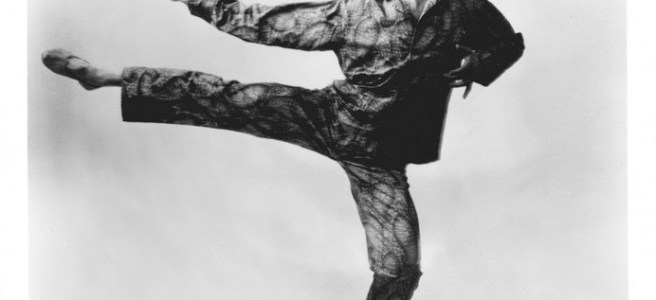
Quote of the day – Francis Patrelle

” CLASSICAL  DANCE  IS  SO  UNFORGIVING . ”

————————————————————————————————–

I found this  quote as single sentence, out of context. It started so much associations in my mind that I decided not to search for the context, but let it stand there in all it’s shortness and possible meanings.

Ivan Vasiliev’s arms – Once more.

If you do not know russian, you are bound to find this kind of treasure, just by chance, from time to time: Kings of the Dance 2010, I think, but performed in 2011? Christopher Wheeldon’s “For 4” danced by David Hallberg, Joaquin de Luz, Nikolay Tsiskaridze and brand-new king Ivan Vasiliev.

Great, amazing dancers, all of them, and it was fun trying to catch all the differences between schools, training and styles – they have each their own way to perform the exact same step, and even a different way to feel/obey/use the music!! Mighty interesting!

But do you know what I liked most of all? Once more? Ivan Vasiliev’s arms!
“For 4” shows his “arm work” at its best. I like his arms because: a) they are able to create such smooth, continuous, perfect lines, from neck to finger-tip, and b) they move, they dance too. They are not just there, parked in the right position, were you expect they should be if the dancer knows his thing – they dance too, along with legs, head, and what else he is using, all together creating a seamless, single, complete movement.

Snapshot - 43
For 4 – Ivan Vasiliev’s beautiful arm lines

I tried to capture snapshots, but they all became fuzzy: his arms never freeze in “becoming positions”, they are never still – they are taken toward that instant that defines/finishes a move, then, for just a fleeting, beautiful moment, they are THERE, and already they are changing again, and again, and again, as much as legs flow through positions and steps.

If you choose low speed to watch the video on this link, you will see what I mean. Watch closely the first minute, and then from 4:59 on for some minutes.

http://youtu.be/TGJ4mL6eoso

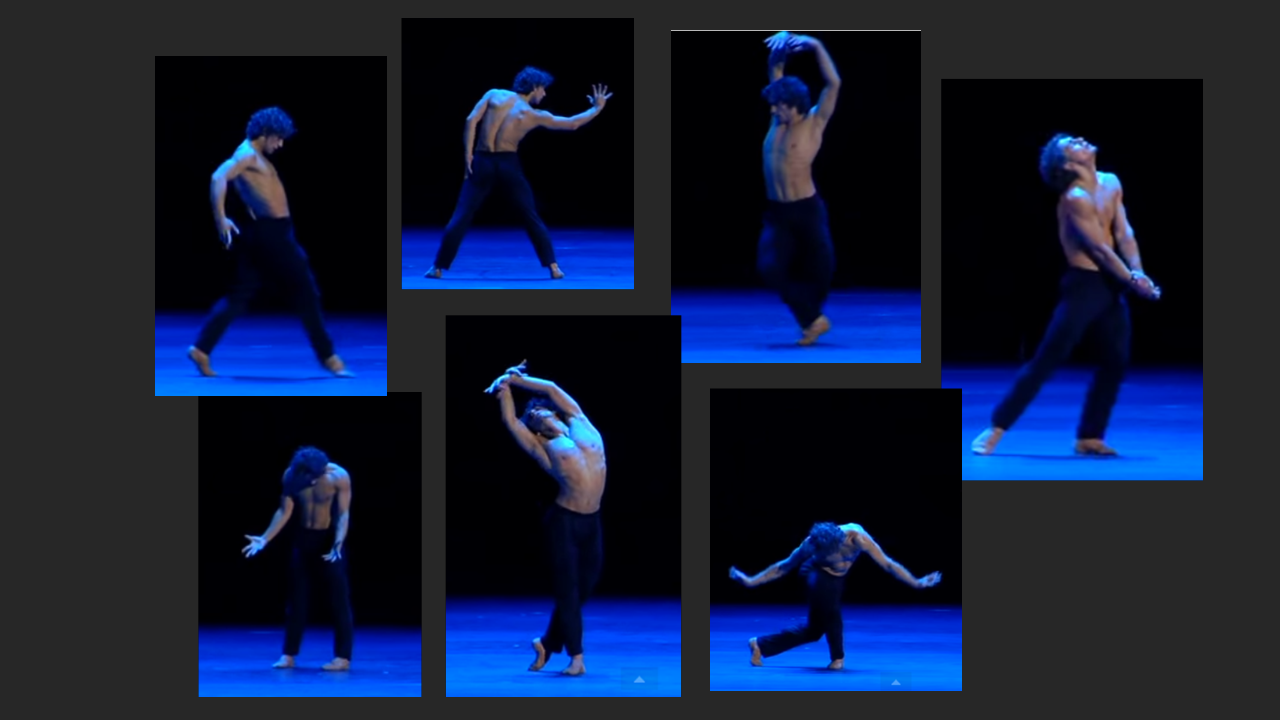
Labyrinth of Solitude is also a wealth of beautiful lines, I didn’t know how to choose, I just picked some at random.

Labyrinth of Solitude

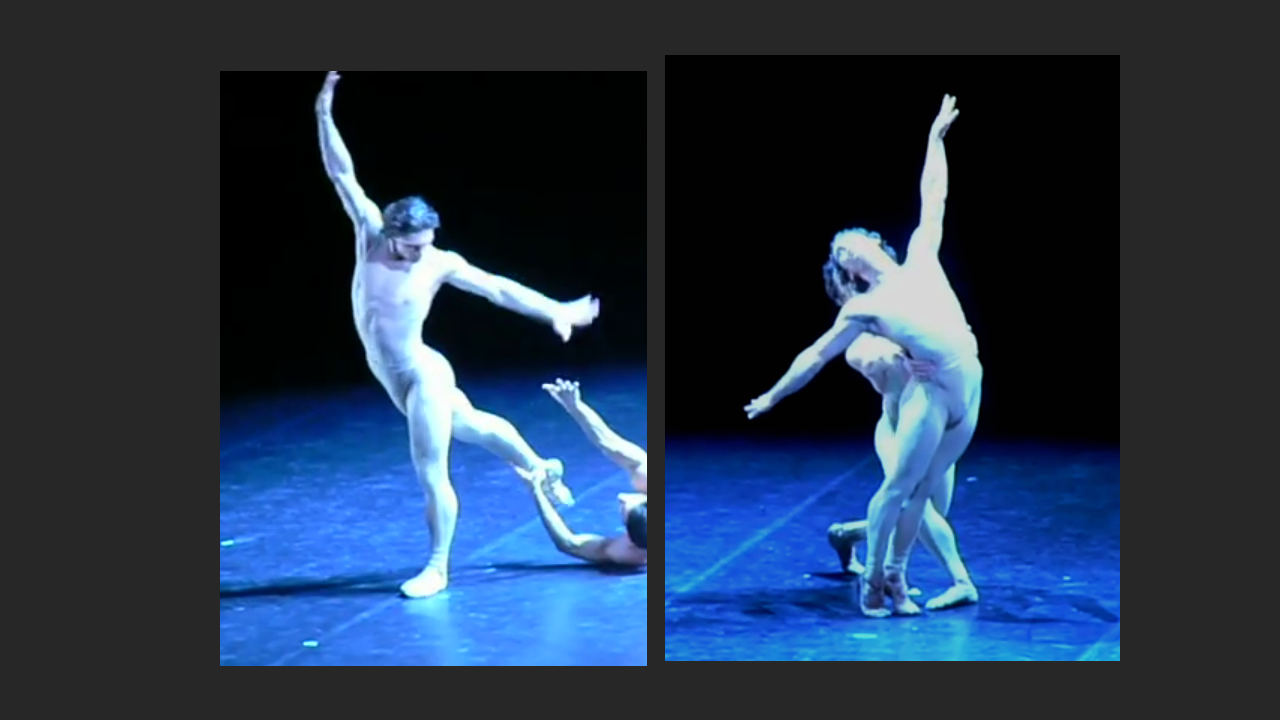
As I said elsewhere, many a “swan” could learn from his wings in Blue Bird and Le Combat des Anges – he moves his arms as real birds (or imagined angels) do: in long, slightly curved, smooth, smoooooooth lines that start in the upper-arm, never in the hand, wrist or ellbow. They make me want to fly, as if I had a memory of been airborne before.

Blue Bird
Blue Bird

Snapshot - 38

Le Combat des Anges
Le Combat des Anges

Snapshot - 35

Am I the only one who sees so much beauty in his arm movements? I never read any other comment about them, although they constantly attract my attention! It makes me feel weird, as if I’m seeing “things”, or as if I’m the only one who can raise her eyes above his legs…  kkkkk! It may be a matter of taste, of course, my opinion just a strange one in a Tower of Bable of different ways to judge Dance…

Quote of the day – Tennessee Williams

“Then what is good? The obsessive interest in human affairs, plus a certain amount of compassion and moral conviction, that first made the experience of living something that must be translated into pigment or music or bodily movement or poetry or prose or anything that’s dynamic and expressive – that’s what’s good for you if you’re at all serious in your aims.”

——————————-

marlon-brando-vivien-leigh-21607
Vivien Leigh and Marlon Brando. Don’t they seem to be dancing?

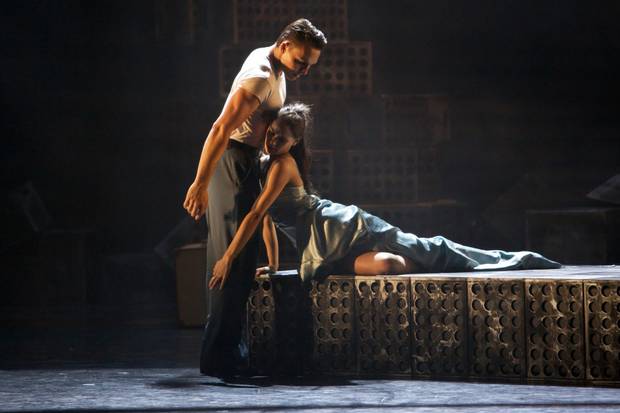
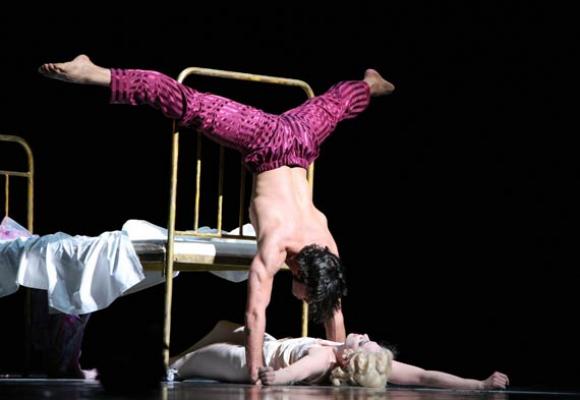
One of Tennessee Williams’ most powerful plays, A Streetcar Named Desire (1947), became a movie (directed by Elia Kazan) that earned various Oscars at the time – a raw, heart-wrenching and desillusioned affair… and an absolute must-see!


Scottish Ballet
Scottish Ballet

Two choreographers did a great job translating   it to dance: Neumeier for Marcia Haydée and Stuttgart Ballet, in 1983, and Annabelle Lopez Ochoa, working together with movie director Nancy Meckler, for Scottish  Ballet (2012).


Stuttgart Ballet
Stuttgart Ballet

Neumeier play is in Stuttgart’s regular repertoire (scheduled next in May, 2015), and an item in my wish-list!


There was some dismissive nose-wrinkling, once more, on these kind of story-telling ballets, “a lesser kind of dance art”… If Tennessee Williams’ were to write a play equivalent to  a ballet without narrative, it would be made of meaningless sequences of beautiful words… and THIS should be some kind of “higher art”?  Oh, spare me!

Natalia Osipova’s Awards – Is anyone surprised?

329156_226067570807890_455786005_o
I’m just as big a fan of Natalia Osipova as of Ivan Vasiliev. And there are others, I just had not time, yet, to write about them all (when I started this blog I had a latent demand of issues I HAD to write about, but now I’m good, I think…).
Natalia is an absolute pleasure to watch. I had no doubt, at any time, that hers would be a brilliant path, she will become a legend.
I remember only too well that when she became a Royal Ballet principal, a lot was said about her lack of clean technique, of excessive energy, of too russian style – the same kind of remark made all the time about Ivan Vasiliev. What will these critics say now? That she didn’t deserve the awards? That we may love her performances, but should not, because they know better?
Ok…

It is nice to see things be shaken a bit there, she brought new spark and life into Royal Ballet’s roles. She’s not a dare-devil as Ivan Vasiliev, has not all his revolutionary potential, or better said, she HAS, but chose not to use it. She chose, instead, a structured, safe environment, probably it suited better her workaholic, perfectionist temperament. She was right, obviously – there are the results!
I was disappointed when she joined Royal Ballet, and when she almost disowned her contemporary experience in Solo For Two. I do not mourn Vasipova as some do (I believe a great dancer brings the best out of any partner, and in that sense, they being apart does a lot of good to other dancers). But she chose the safest path of all… (sigh). A loss for the changing process that is happening in Dance, but if she is happy (I hope she is…), and if she feels it enables her to get the most out of her talent, so be it! We surely cannot complain!!!

I wonder if there will come a time when, coaching a soloist in a new role, it will be “no, no, look, that’s how Osipova did it!” instead of “that’s how Dame Fonteyn did it”. I loved Dame Fonteyn in my (her) time, as we all did, and I still love her10408107_1548177652131962_1708838414395946022_n. But I must be candid: now I love Natalia Osipova more, she is a more complete artist. Margot Fonteyn WAS the best, really was, but… Dance is changing, and for the better. Criteria that applied 50 years ago, and were absolutely right at the time, are not valid anymore.

So they are “hot” ballet dancers. Good!

IV&MV

I liked this article in Tatler (RU), with lots of beautiful photos that associate ballet in people’s minds with young, sexy and fashionable dancers. Excellent!

So they are “hot”, a charming couple that young people can identify themselves with, as they do with sport, music, movie stars – why not ballet stars? People under 35 that do not dance are underrepresented in ballet audiences, I bet because of ballet’s old-fashioned image. But even ballet is changing, so let them be lured in any way to a ballet evening – let them see Ivan Vasiliev dance just once…

I’m sorry for all defenders of ballet’s outworldly purity, but we live in 2015

Link to the whole series of photos in Tatler:
https://www.facebook.com/media/set/?set=a.757982010946729.1073742058.116589208419349&type=1

DANCE – KNOW THY AUDIENCE!

For some time now I have been wondering, and making comments, on the audience of Dance. I believe that the performance of ballet professionals and the big companies’ stagings were more foccused on pleasing dance experts and the conservative part of the audience, neglecting a wider one that could and would enjoy Dance, and ballet, it just some changes were made…This was more a feeling that a certainty, and of course I could be wrong.

But I have found a survey about audience made in 2010, in USA, comissioned by Dance/Usa , a national service  organization for the professional dance field, within the scope of one of their initiatives: EDA – Engaging Dance Audiences. The survey was made by WolfBrown, a specialized agency that provides ” qualitative and quantitative market research services to a wide range of cultural organizations.” In total, 7,454 dance patrons completed the survey.

*****6 out of 10 in the audience are dance professionals or ex-professionals

Now look at that:
“A quarter of all dance buyers take dance lessons or classes at least occasionally, and another 33% used to, earlier in their lives.” That’s 58% of the audience, or 6 out of every 10!”

WolfBrown sorted the audience, however, by another criteria:

– Active or Serious Dancers are people who regularly take dance lessons, perform in front of live audiences or choreograph. They constitute 2 out of every 10 buyers. I suppose this means: they are either active dance professionals or actively training to become professionals.

– Social Dancers are people who dance socially, either regularly or occasionally, but who are not “Active or Serious Dancers.” They constitute 38% ot the audience – this means 4 out of 10, and among these, 3 are ex-dancers.

– Non-Dancers are all those not included above. They constitute just 43% of ticket buyers!

Dance AudienceIn the report, there is this cautious remark beside this graph:

“– In other studies, we have observed the presence of artists in the audience, but not to this extent. The larger point here is one about the inter-dependence of different players in the dance ecology.”

************************************ I want an inspiring, uplifting experience

DanceAudience Motivation

“To experience the kind of magic only Dance can create” is not an item in their list… No wonder, as my clumsy, unprecise concept of “magic” means the kind of experience you have when exposed to Art: an experience that may be anywhere from the most subtle, unconscious to the most overwhelming one, but always touching  deep existential strings. Note that “to have an intense emotional experience” is low on that table, while “to be inspired and upflifted” is at the top. I imagine that respondents, like me, regarded the top one as a life-changing experience, and the  “intense emotional experience” as any kind of “emotional”, including the  predictable, shallow kind that newspapers and trash-talk-shows use “ad nauseam” to increase their sales. So I chose the top one as the closest, in fact as a synonime to my “magic”, and hope I’m not pushing it too far – because “magic” in the top position agrees with all I believe in!

The report states that to Active or Serious Dancers  the most important motives are:  to engage intellectually with the dance or choreography / to energize your own creativity / to see great works by the masters / to discover new choreographers and companies. This is a   pragmatic group, they want to enhance their skill and specific knowledge.

It follows that  “To be inspired and uplifted”  stands  on the top of the list because the Social Dancers and Non-Dancers want it,  it’s THEIR principal reason. If no real “magic”, nothing really special is created,  it will be a disappointing experience to THEM.

The performers on stage know that their peers are a large part of audience (roughly 60%) – with their keen, knowing  eyes hefted on the smallest movement, possibly looking for faults! I wouldn’t be surprised  if the wish to concquer their respect and praise became stronger than anything else….

That’s why I love performers who are more foccused on creating magic than in showing off their excellent technique. Remember: the most important motivation to see any kind of production, to a large part of the CURRENT audience, is the wish “to live an inspiring experience” – it probably is also the motivation that can win more “outsiders” over.

************************************Yes, I’m willing to see an unfamilar work

One last comment, now about constantly re-staging familiar works. Respondents were asked to agree or disagree with this statement: “I prefer to see familiar works that I know I will like rather than seeing unfamiliar or challenging work.”

And see! roughly 6 out of 10 disagreed! including Non-Dancers! If you take  10  Non-Dancers, then:
1 of them prefers a familiar work (only one!)
3 prefer new works
3 are willing to either kind AND
3 have mixed feelings about this (still hope on them!).

But there is an exception, and an expected one: when it comes to ballet productions, 45% prefer familiar works – the conservative traditional-ballet-loving audience I always talk about!

********************************************************* Young audience?

The survey also tried to find out about technology-based alternatives of watching a performance. All groups prefer live-performances (OF COURSE!, who wouldn’t?), so interest in technology-based viewing is not that big. Anyway, two conclusions stand out for me: the younger the audience, more interested in technology-based possibilities they are, not instead, but ALSO! A clear trend! The only exception is about sites with pay-per-view performances – these interest all ages and groups almost the same way.

(Don’t forget we are talking about audience with access to live-performances! What to say, then, about audience that has access to Dance ONLY through technology? Nobody remembers they exist, a “potential, still unexplored market”, in business wording…)

——————————————-

These results must be viewed cautiously, of course. WolfBrown analyzed north-american audiences, in other countries they may have a different behaviour, and great companies like NYCB and ABT did not adhere to the survey.  (If I were bold, I would bet that Non-Dancers are an even smaller part of the audience of the great companies…)  Even so, to me these ARE interesting results, in that they prove that my complaints are not without reason, and in that it is the only effort to analyze Dance Audience that I know of, so far.

Link to report: < www2.danceusa.org/uploads/EDA/EDA_NationalSurvey_Overview.pdf >

Quote of the Day – Tamara Rojo

“I thought being a dancer meant being in a pool of creative people always discussing the meaning of the art and where it should go towards, and what it is that we should be creating and what we mean for the larger society, how we defend, lobby and fight for it.  Those discussions very rarely happen. And that was disappointing for me.”

————————————–

Tamara Rojo is Artistic Director and Principal Dancer in English National Ballet. She is doing an amazing job as AD. In her interviews I always find sentences that give form to what were, in me, just vague feelings until then. I love the way she thinks about Dance and about dance professionals.

THE TOWER OF BABEL – OPINIONS ON A PERFORMANCE

In a party I’m telling a friend I just bought tickets  to  see a certain performance.A stranger in a group nearby turns around and says “Oh, I was there yesterday! It was… (whatever)..!”. What can I do with his opinion? I don’t know “from where he is speaking”: has he a dancing background? in a specific kind of dancing? of Dancing?   Vaganova,   Ohad Naharin,  he is older – perhaps Merce Cunningham? What is “Dance” to him? Or what should Dance ideally be? What were his expectations BEFORE taking a seat?  What is beautiful in his eyes? Why did he go? What place has Art in his life? What other performances did he see before this one? …

I will not ask all these questions, of course (not fancying be elected the party’s Bore#1), but if I don’t know their answers, how can I judge his judgement? Dance became so multifaceted, there are so many movements (cultural, not physical), styles, techniques, that sprang out of such from-ground-up-different premises, that pursue such different goals! How can a Vaganova dancer have a helpful opinion on a Crystal Pite performance? The other way round?

How can anyone have a really helpful  opinion on any kind of Dance that is not part of  “his own” background, and based on his own values and tastes? But there is  more: everything is changing fast in Dance. Premises become outdated, styles and techniques disappear with their creators, whole companies shift their goals with a new AD…

I believe these are important reasons to explain why opinions on a performance are becoming a Tower of Babel. Opinions are sometimes so diverse, they seem to be about different performances. We ALL  became incompetent to judge the the whole range of styles and techniques, to grasp adequately premises and goals of  every performance, we all…  just judge from where we stand!

When we hear an opinion, we must switch our “careful mode” ON, because we don’t know “where it comes from”.  Also, when we have an opinion, it’s good practice, even an ethical one, to tell openly where OURS comes from.

So this about common viewers, but then we have the professional Dance reviewers! Are they any different?

Why would they be?

I have been trying for some time now to write about the “discourse about dance” made by reviewers: it is also a very confusing discourse, but sadly  (even dangerously?) it is authoritive one, the “legitimate” one, not because it is less “localized”, or really that much knowledgeable, or more objective – it has authority because of the press power, and because very little is publicly said and discussed about Dance, dance professionals seldom “think Dance” (more action-proned, I believe…).

What follows are excerpts of professional reviews I collected about ENB’s Swan Lake, production of Derek Deane, cast was Alina Cojocaru and Ivan Vasiliev.  I could have chosen excerpts about corps, great Alina Cojocaru, James Streeter, staging, settings, orchestra  –  all received contradictory comments,  but when it comes to Ivan Vasiliev, opinions are famously divided, and here became so contradictory, you feel the need to sort out the author’s biases, to know who you can trust. I have a dramatic friend who would say: yeah, comical, if it were not tragical (for Ivan, he menas). It seems IV himself does not take them too seriously, or he would already have turned to football, or gone crazy.

Each paragraph cites a different reviewer, ALL  that I had free access to on the web (if you know of someone else, please inform me!). No names, because I’m not analyzing this or that reviewer, but them all as a group,  a group  with  authority to discourse about Dance.

…Vasiliev is not a naturally dramatic actor...

…Vasiliev very nearly turns this most female of ballets into a male narrative. He almost kidnaps the drama – not with his eye-popping leaps, although these are impressive, but with urgent acting that uses his entire body. A lean of the torso to indicate longing, a bow of the head to suggest reflection, and outstretched hands that tenderly hold his precious Swan Queen…

.. he’s a delightfully sincere, satisfying hero, partnering his leading lady with tender steadiness and emoting his heart out.  Purists prefer slenderer, leggier chaps, but Vasiliev’s awestruck gentleness in the Act II Pas de deux and his heartrending contrition in Act IV were everything I want in a Siegfried.

… he offers too few of the qualities — emotional, physical — that must define a traditional balletic Prince Brooding, heavy in presence, his Siegfried was a stranger to this presentation.

… His acting, more than anything, is impressive: the sharp contrasts of ecstatic happiness and distress bring a colourful and exciting light to the production.

…he brings a remarkable degree of softness to this most heartfelt of soliloquies … his was one of the most openly expressive character performances as Siegfried that I have seen … . From many meaningful examples, one…

… This production retains the full mime sequences between Siegfried and Odette which one suspects isn’t a element he would have encountered in his training in Russia, but he dealt with these very naturally and his bow to Odette when she tells him she is a princess is as courtly as you could wish. There is a prince there after all.

… (Vasiliev) has trimmed himself down in the wake of some fairly rough performances … his feverish, silent-movie heroics, which give us an idea of what it must have been like to watch the dramatic Soviet dancers of the 1930s … Emotionally, the pair are forever at cross-purposes, a confusion that reaches its apogee in Act 4 when, without warning or apparent motive, he races across the stage and hurls himself to his death.

during these last 20 minutes (Act 4)  that the ballet found its truest poetry. From the moment Ivan Vasiliev’s Siegfried sank to his knees, begging forgiveness from his doomed ballerina Alina Cojocaru, you felt the shiver of impending tragedy. Vasiliev looked like a man harrowed and hollowed by misery; his big, exuberant body sagging under the burden of guilt. … given its power, it’s hard to pin down exactly why the stellar combination of Cojocaru and guest star Vasiliev didn’t deliver in the preceding acts.

… Mais surtout, c’est dans la construction de ses interactions avec sa partenaire qu’il a gagné notre suffrage....

…They were terrific on their own but excitingly, Cojocaru and Vasiliev also gelled magnificently in the big pas de deuxs. Their lakeside duet of introduction was exquisite – he was a wonderfully supportive and restrained partner which allowed her to trace her footwork through the air with the finesse of a master calligrapher. A superbly tender rapport had been established, and the famous black swan pas de deux revealed fierce passion…
Dramatically, Vasiliev veers to emotional extremes, although he’s clearly trying for complexity (but perhaps we shouldn’t be able to see that he’s trying)…

one its finest current interpreters … From the moment he came on stage he was the Prince all eyes focused on, even when not given anything to do. The sadness of his Act I solo was palpable … he was very appealing in the way he constantly reached out to her unwilling to let her out of his grasp … admirably stayed in character throughout … In the last act, reunited with Vasiliev’s Siegfried, she (Alina) came into her own and together the emotion of their ultimate sacrifice was all-too-believably human.

————————————————–

Try mixing them up in another ways, take other excerpts… You would just highlight other contradictions – still The Tower of Babel!

What follows now are excerpts from audience’s reactions, found on blogs and again,  ALL  I could access:

…Second viewing of the Cojocaru/Vasiliev cast, and yes, it was as good as I thought it first time around.  There is something about Vasiliev’s (let’s call it burly masculinity) physique that really works for the Prince – the swan is initially wary of him, and it makes perfect sense when the prince looks somewhat dangerous and overwhelming compared to the swan, but then he shows a personality tempered with care and tenderness that overcomes the initially threatening appearance…

…Ivan displaying a new (and unexpected) talent for the princely roles. He reigned in his usual exuberant display especially in Act 3, (though he was still brilliant in the Solos and Pas de Deux)  channelling his energy into his passion for Odette, and stayed within character throughout. …

… Vasiliev didn’t quite work for me, I admit this may be because I was too far away to catch nuances of his interpretation…

… What a lovely production and it was a great evening…I have never seen Alina dance before, although I have seen Ivan, but not in such a classical role. The white Acts (1 and 2)were sublime and the black Ac t(Act 3) terrific. The tragic ending (Act 4) was so fitting. Very pleased that I managed to get a ticket.

… She (my wife) was significantly less impressed by Ivan Vasiliev’s Prince, and she was most decidedly unimpressed by the tempi adopted for parts of Act 2…

… ENBs SL is a lovely version. Vasiliev was good and a very genteel Prince. He treated Odette so tenderly , …

 … Vasiliev might not be a born Siegfried, but the man looks good on stage whatever he does and the partnership worked pretty well. Very nice PDDs. Though I couldn’t quite suppress a slight giggle when he delivered the most dramatic eye roll I have yet seen, on stage or off.

… He was, and I am unsure how to put this, a little vacant. …His expression very much ‘dude where’s my swan’ through most of the drama. There was no ardour in kissing Odette’s hand, scant astonishment (as I have seen from some dancers) when he meets her…. Only in Act 3 did he seem to come alive, I did in fact exclaim a ‘wow‘ under my breath.  There was the Vasiliev I had heard about. It was just a shame that at times his acting didn’t match the dancing…  Here, (Odette’s) heartfelt glances and looks – played to Vasiliev’s slightly more monotonal expression

…On the other hand, I couldn’t take my eyes off Vasiliev. … the slightest tilt of his body suggested his pain and boredom at court, his anguish in the later stages.

—————————————————-

If you read this far: are you any wiser? Were reviewers, as a group, more objective or helpful than audience as a group? Could you spot how diverse bias, values, pre-conceptions, pre-judices?

Maybe you noticed, as I did: there are more positive remarks. That’s nice, it is a relief when a performance is so remarkable it overrides pre-conceptions, and the Tower of Babel languages become more similar.

What  I value most, however, are comments written a short time after the performance, when the author is still under its spell… BECAUSE of it’s spell – I trust them more than a purely intellectual text that it took days to create.
And I don’t take into account those that like ballet restricted to pure visual aesthetic (and usually see flaws more than anything else). Why? because I have my one pre-conceptions. For me Dance is Art when it is Form+Content. Form+Content make possible what I,  not having found a better word, call “magic”. My (certainly biased) opinion is:  what ENB, maybe Tamara Rojo made possible, WAS  Art, and what Ivan Vasiliev and Alina Cojocaru created, WAS Art!…

 

Limitation and Innovation: the Art of Making it Work Anyway

Just found this post, I liked the ideas and comments, makes you think…

Nadia In Her Own World

On Monday, I went to a lecture by Twyla Tharp about her book The Creative Habit. Her talk included some ideas about how to develop creativity and stories of her own experiences as, peppered with a fair share of strong opinions and unfiltered sass. But what really interested me was hearing the about her modest choreographic beginnings and the extent to which her early career was shaped by adaptation to circumstance.

Her presentation stressed the importance of structure as a framework for creative innovation. This principle, though it might sound a little contradictory to someone with a more romanticized notion of free-flowing creativity, should ring true with anyone who has ever taken an improv class and realized that the instruction “go across the floor without lifting your left elbow off the ground” results in a lot more interesting movement than “just do anything,” or even anyone who has found themself making more progress on a paper during…

View original post 428 more words

Quote of the Day – Daniel Nagrin

“They don’t want to deal with people. They want to deal with things. They want to deal with extensions and plies and beats and words that don’t have to mean anything. They’re not interested in people. They’re not interested in you. They don’t plumb your depths. In other words, they’re not humanists.They’re playing with things.  They make dance a thing.  A thing.”
(interview when he was 85 years old, talking about post-modernism in Dance, exemplified by Merce Cunningham’s style).

Danile Nagrin was an actor and a dancer, choreographer and teacher. He wrote, among other books “The Six Questions: Acting Technique For Dance Performance”. He was deeply influenced by Stanislavski’s Method, and a fierce humanist.

I’m a fan!!! And we have something in common… in the Introduction of The Six Questions he says: “I may believe fiercely, but I’m sure of nothing.” (italics are his)  If you read my ABOUT, you know that’s exactly how I feel.

Link to the interview is: <http://jashm.press.illinois.edu/12.3/12-3Interview_Roses-Therma114-119.pdf&gt;