
The Swan Lake Ballet Turned Into Theater

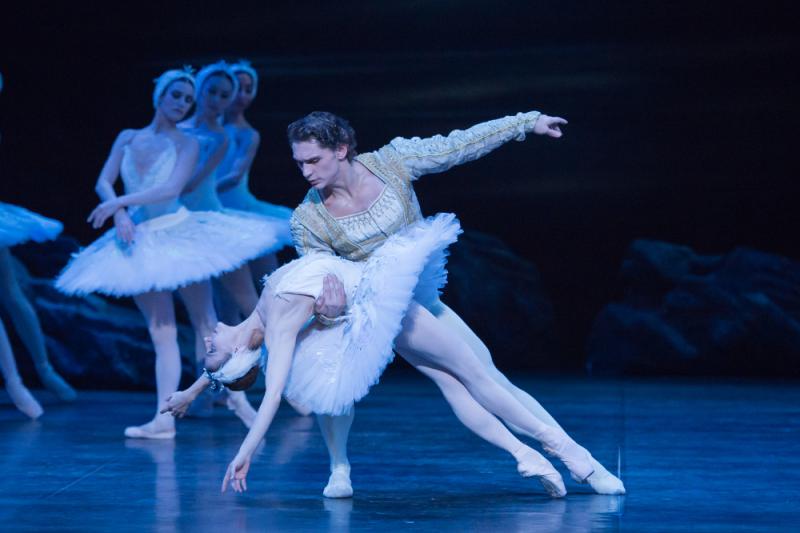
I had radical positions about pure-classical-Ballet, but they just suffered a good shake!  As almost pure-form Dance, I dismissed the great classicals as unimportant in current days  (and lost some readers by doing that…). Vasiliev’s successful performance in Swan Lake, the way he interpreted his Siegfried, making people forget about ’emploi’ and Basilio/Philip and turning him into one of the best Siegfrieds ever, proved this blog’s point about the importance of Content in Dance. But he would not have danced Siegfried if Tamara Rojo had not invited him, and let him free him to act. In fact, I’m sure she invited him BECAUSE of that. Probably all Principals are allowed to act, there is even a real kiss (!!!) in last act, and Tamara Rojo herself was accused of a “too passionate” one on  her (Matthew Golding) Siegfried. She calmly answered:”“Well, I thought, after three hours on stage, I deserved it. Look at him. Who wouldn’t?” .(kkkkkk) Isn’t she great?

But she is a revolutionary AND wise: ENB retained all the classical form, with beautiful staging and competent dancing, but allowed acting TOO, and as a result the show is a huge succes!!  ENB showed ME that that the classicals CAN have content, if just someone is bold enough to make necessary changes (I thought no one was…)!

But I’m not satisfied…  ENB is an exception, not the rule. I suppose people are so used to the white ballets, and their lightly coloured companions, as they are, and they ARE so beatifull (I agree!), they cannot understand my prejudice, it sounds  as if I am not REALLY a ballet-lover… I was thinking: how could I show someone what bothers me? So I came up with this idea of comparing them with Theater somehow, and it ended up being a most amusing task. Please, if you love Swan Lake, don’t be mad at me, it’s just a joke!

—————————————–

(In a former post about Dance x Theater I reached the conclusion that between Dance and Theater there are just two major differences: the media – voice x body, words x movements -, and the range of ideas and emotions they can express, that is not fully coincident.)

THOUGHT EXPERIMENT: Swan Lake Ballet transformed into Theater ————

There are no complex emotions, no complex characters, no complex plot in SL, it is well within the coincident range of ideas and emotion both Theater and Dance can express, so this should not be an issue.

All we must do is change the media of Swan Lake from body to voice.

Ballet does not use voice/words, so, the other way round, we will not use body and movements in our Theater play.

The mime transposed to words:  very old-fashioned words, arranged in simple, few phrases, ponderously spoken, with lots of intonation, but almost telegraphic in their shortness. The words would have to be chosen with great care,  so each phrase carries the same amount of information of the corresponding mime.

The dancing sequences transposed to voice: a lot of sounds emitted in sequence, sounding gorgeous together, but without any meaning.

Acting during pure classical dancing is not required, or even disapproved, so the corresponding sounds should not express anything.  They could even become a song, but the song must be made in such a way as not to stir any feeling in the audience, except pure aesthetic admiration (if this is a feeling. Is it?).

If there is mime during dancing, corresponding words /phrases, of course, would be said in the right places during the sequences of meaningless sounds.

To make a fair transposition, actors would not be allowed to move at all, including facial expression, except they could smile to show how easy it is to make all difficult vocalizations (this kind of smile has nothing to do with the story, so it can stay).

As a whole, our play would be made out of short sequences of words/phrases, that would tell the story or inform what is going on, and long sequences of gorgeous meaningless sounds.

Light and settings could be the same, but we should add some seating arragements – it will be hard on our actors to stand still during the whole play, they better be seated. And then we would also want to change tutus to something more comfortable, now that they are sitting.  We design instead sparkling white garments with great, high, wing- like scarfs  that can flow constantly over the male actor´s face seated next by, to blind and/or hide him during his vocalizations, like tutus do in PDDs.

Done! Now we take seats in the audience and watch the play.

….

We bring Tchaikowsky’s music back, it is not usual on Theater, but we have to do something…

….

Although we  can see some very elegant, sophisticated people making positive comments about our break-through staging, most of the audience is yawning or shaking their heads, and they look definitely dismayed. WE are dismayed. It didn’t work.

THOUGHT EXPERIMENT 2 – A Swan Lake Theater Play, and back to Ballet——

We surrender. We need more to stage Swan Lake as  good Theater, the more so if we want it to be, not just good, but awesome (it should be easy, SL has great possibilities, it is all made of symbols and myths that permeate our culture).

So we forget, for the time being, all about Ballet, and give us freedom to use whatever resources there are in Theater to create a magical, impactful SL. Not being experts, we come up with just 1,859 (approximate number) ways to turn our play into really good Theater and  an unforgettable experience.  We design new, timeless settings and costumes (myths are timeless) – they become impressive, half gothic, half dream-like;  we write powerful dialogues;  we embed layers of meaning both in settings and written text and choose carefully our actors, capable of imparting deep, vital emotion – of course,  we bring body-language back, so they can use all their acting skills.

AHA, great success!!! Full houses, months on stage! We are very pleased with ourselves.

Now we realize we could make a transposition the other way round, back to Ballet! We have learned what works, it could probably enhance any Ballet performance too. We think about…

….

….

No, a total transposition would decharacterize SL in such a way, it would not be Ballet anymore.  We don’t want to make Ballet lovers unhappy, so maybe we use just some of the resources, in a way that will not shock them?

Let’s take the powerful text first. Text is choreography, we must change choreography. We try to create new movements, but are severely limited by Ballet canons; we sequence movements in new ways that are more meaningful, but there are just  that much movements available, and structures we cannot change, like the Grand PDD.  We try hard, but are unable to bring deep content to the 32 fouettés, for example. The outcome of our effort is almost none.

Well,  we can choose more expressive dancers, can we not? A new problem: after we select ballet dancers with the right body-types, among them those with the required technical level, and among them those with great acting skill, we are left with… none! So we change our selection criteria, and choose dancers that are great actors, and that’s it.

Next, we try our hand with body-language. In Theater play it was a decisive resource in imparting all that profound emotion, life and meaning – and this should be easy, as media in Ballet is the body. So we proceed to embed body-language into dancing.

…ooooohh…  we had forgotten! Using body-language in Ballet is met with great resistence: it is considered unrefined, incompatible with Ballet’s purity, to some it is even disturbing. And it would mar the perfection of the choreographed lines – without perfect lines, Ballet is not Ballet! We must give up. And fire our expressive dancers, they are all very popular, that means expensive,  and we cannot use their skills anyway…

As a last resource, we change settings and costumes to the new impressive ones – and are showered with complaints: ‘Ballet deserves a costly, sparkling, luxurious frame! How drab and cheap yours look! Where are all the pearls, stones, laces, plumes, bows, embroideries, flowers, frills, pleats, drapes, gold, silver, brocade, velvet, silk  that belong here? Where are all the plumed tutus, the capes, veils, hats, crowns, tiaras, wigs, fans, scarfs, gloves, brooches, pins, lockets, necklaces, sashes, boots and high-heels that make out of  SL such a great show?’

Ok, Ok, Ok! Out with them, then…

(looking at each other)…  (sighing)… (realizing a lot of disapproving looks all around us)… (looking at each other again)…

You know what? That’s it! Our notes into the waste-basket, and we go see Billy Elliott!

——————————————–

Jokes apart: I was wrong, I DID throw the baby away with the bath water.

There is much beauty in the classicals, and there are many ways to bring Content into them, so I should not dismiss them so easily.

I really believe that, if certain changes were made in the classical ballets, their worth would soar up, and they would enchant a wider audience that deserves to be there,  that wants to be there. Me, for example.

I’m sure a compromise between tradition and meaningful content is possible,  without loosing the essential beauty of the classicals. It is sad to let such emblematic works be a mere display of technique, beautiful lines and expensive golden glow. And remember, to the audience of non-experts,  there is not even  technique to be seen, except as quantities: height of a jump, number of turns, angle of an extension, they are unable to perceive all the fine details a professional can enjoy.

Some re-stagings introduced major changes, like Romeo and Juliet by Nacho Duato in Mikhailovsky. As far as I know, it’s being done in smaller companies, never in the Sacred Temples.  As I have not seen more than fragments of  these efforts, I’m not able to judge what came out of them: how far they got;  if compromise was wisely made; if they were able to win new audience.

As I already wrote elsewhere, Shakespeare’s plays are still there, but no one believes they must be performed now in the same way they were  back in XV century  (except as a curiosity, or an occasional tribute).  Or should we demand that Juliet is performed by a young man wearing a wig? That would be absurd, even more absurd than dancing wearing tutus…
Make Dance World-Wide Available – Please!

It is REALLY frustrating! There are, all around the world, ballet lovers that do not have the means to travel thousands of miles to those few cities and countries where everything that is important about Dance is going on. Like me, for example. All we have are terrible jumpy, unfocused illegal 2 minutes videos, often recorded using just smartphones, to follow the new ballets in every season, the important choreographers and the dancers we admire. If at all.
Why so few performances are recorded professionally? Why are ballet companies so jealous about their copyrights, if they do not release recordings they could profit from? There must be some serious business issues well beyond my scanty understanding, because it does not seem to make any sense. I heard about staggering Union fees to record inside theaters, but is this the decisive motive?
Are they afraid people would buy a record instead of a ticket? Not ONE ballet lover I know will trade a live performance for a recorded one, if there is ANY way he could be there! But maybe he would buy a recording too, afterwards, to see it again and again… And all those for whom a live performance is out of reach? It doesn’t make sense!
DVD recordings have an aditional problem. There is something called DVD Zones, that divides the world in 5 regions. A Zone-1 DVD cannot be played in any other zone! The Zone you live in is hardwired into all DVD-Players you can buy there, and it cannot be changed.
But it is possible to release an “All Zones” DVD, like Ratmansky’s Flames of Paris with Osipova&Vasiliev&Savin. Why are not all Dance DVDs All-Zones ones (at least those about performances)? After all, Dance is not limited by language as Theater, it is universal… It doesn’t make sense!
Performances live streamed to Movie Houses? Don’t reach my country. Performances available on specialized sites for a fee? “We are sorry to inform you that our streamlining/cloud/downloads are not availabale in your Region…”.

So it’s illegal videos or nothing…
Have companies/producers no interest in widening their virtual audience? Maybe the virtual audience is too small, from a cost/benefit point of view? Can be, but if it is true, I suspect a falacious circular logic could be at work: if they don’t make records available, they don’t have virtual audience; if there is no virtual audience, there is no point in releasing records… In YouTube, terrible quality videos, when featuring great ballet stars, are viewed hundreds of thousands times!
To be fair, eventually an important company includes my region in one of it’s tours. Then I can watch my n-th Sleeping Beauty performed by first soloists, because, if they come that far at all, they always bring us either Swan Lake or Sleeping Beauty… I suppose we are seen as too ignorant about Ballet to appreciate anything else. And maybe we are, considering how difficult it is to lessen our ignorance! Even when we fiercely seek to know more!
Of course important ballet productions cannot travel often around the whole world, we know that. But they can be recorded! Any new staging, any break-through performance, any new choreography in it’s first season, any performance by great dancers should be recorded!

Then they could be offered at whatever price, as DVDs or on the web, or published on the web for free if adequate funding were found. A way must be found, for there so many benefits!
They would please ballet fans, constitute historical record, help all kinds of professionals involved with Dance to improve their skills…
We are in the 21st century, for god’s sake, the communication age, the information age! So DO INFORM! DO COMMUNICATE!
Please, make Ballet, make Dance available to us all! Please!

IVAN VASILIEV ACTED SOCKS OFF…

I surrender! I thought I had already seen one Swan Lake too much, but PLEASE I WANT TO SEE THIS ONE!
I was hopeful on the Alina+Vasiliev partnership, but they exceeded by far my expectations. “Poetry in Motion”, indeed! “Like vodka and caviar”!

Of all that was written about this Swan Lake, I liked Sarah Crompton’s informal tweet the most: “Impressive Swan Lake @ENBallet last night. @DancingAlina on heart-breaking form and Ivan Vasiliev acted socks off as well as flying thro air”…

The first review I read must have been written shortly after the performance – it appeared only a few hours after. It made me so happy I suffered from a recurring beaming smile all day long – a day with lot of appointements, I had to wait impatiently until the evening to learn more about audience and review reactions – and then I was even happier. Yes, I am a fan of both of them, specially Vasiliev, but what was more important was they had proved, even to myself, to what degree what this blog defends is justified and right.

I knew that Alina Cojocaru is wonderful, excelling both in technical as in acting skills -I’m her fan.  “Her Act IV, though, is terribly affecting, all frail hopelessness in the knowledge of her inescapable approaching death.” The swan role may fit her like a glove, but she went well beyond dancing it beautifully.
Vasiliev’s case is different. Audience and reviewers had identified him with his bravura roles to such level, that they did not know, anymore, where the role (even choreography) ended and Vasiliev began… they could not stop seeing this “chimera” everywhere, and it was getting worse during last year. Some are still mixing things up, but as a whole, the stunned reaction to Swan Lake is a relief: it seems he was able to lift at least some of the confusion resting upon their minds.
Swimming against the current (a pretty strong one), I always saw his stage behaviour as just acting, not a new personality – probably because I always valued Vasiliev’s expressive power as much or even more than our usual tricks – because of the way I see Dance. His performances in widely different kinds of roles are always in my mind, I try not to be fooled by the stage-filling showman of bravura roles. Since the beginning I placed heavy bets on his acting talent – again and again he has proved me right, stepping well outside any stereotyped image and making a great job of bringing content to dance. Every time this happens, I forget my place as the grateful fan of a great dancer, and become SO proud of him, this unwittingly champion of this blog’s position! With his Siegfried, he once more showed that long-standing rules of Ballet (like emploi) should be viewed suspiciously, and that a lot of assumptions and prejudices that had been piling up about and against him were just  *********, I mean, silly.

But I was wrong too, in my prejudice against what I call hard-classical ballets – I believed they were hopelessly pure form – dismissable except for being beautiful – and he rekindled my interest in them…

“…one its finest current interpreters…”, ” …I hope ENB might think of persuading him to return in Giselle as he would excel in this too…”, said one reviewer.

So much for emploi…

His triumph. And winning one more challenge,  he also gives Dance one more push forward. Great!!!

————————————–

Important reviewers must be intellectual, knowledgeable and sophisticated in their opinions, or they would not be reviewers. I suppose they struggle hard against being carried away, so they can give us an objective, expert-wise opinion. It’s their loss (see Sir Ashton’s quote in this blog). I’m relieved I’m not under that obligation, and free to enjoy without second thoughts.

Most reviewers, specially the important ones, dwelled, once more, in… “their usual tricks”, as I will call them from now on: lenghty paragraphs on Vasiliev’s body shape and technical flaws. (Sigh). His height and thigs, AGAIN? do they not tire? It has become a boring issue by now – all audience knows how he looks by now, since all have eyes, too! And are able, and entitled to form their own opinions on the visual aesthetic of dancing, ’emploi’ or not. And technical flaws: boring TOO! all non-experts  are unable to see them – provided they are there, of course – so what should they do: start looking for them and spoil the pleasure on the play as a whole?….

Dance reviewers should consider – seriously! – stop writing from a Dance millieu’s perspective, and start writing to a larger audience. This kind of remark neither informs me of something more I should know, nor is helpful to a growing understanding of Dance. What the audience would like to know is: what was so special about this performance, that made me like it so much – or what was wrong with this performance, that I couldn’t like it?  THIS is educational… If a dancer makes such technical blunders that it spoiles the whole thing, this is the moment to point them out, and explain them – the audience will understand, and then avoid similar experiences. If they loved a performance, and a reviewer sees flaws only an expert can see, what should they do? Repent of their liking and start disliking?

Dance x Theater, why so different?

424699_358283020919677_1691741353_n
Two kinds of acting: traditional in the corps and Giselle’s mother, and believable body-language in Albrecht.

What are the differences, and similarities, between Theater and Dance?  I began to think about because I always wonder why acting, in Dance, is so peculiar. I’m by far not an expert, but I can figure at least some common-sense  answers for myself:

  • Both use live human beings as their media
  • Both use stage
  • Both have thinkers (writer/choreographer) , doers (actors/dancers), and enhancers (designers)
  • Theater specifically uses voice to communicate through words
  • Dance specifically uses the body to communicate through movements
  • Through the voice you can easily express any kind of idea, even complex ones, like Marx ideas about added-value, or how to solve Pithagoras Theorem
  • Through the voice you can express emotion, but the voice alone rarely is enough, almost always body-language will have to be added
  • Through the body you can NOT express complex ideas,
  • Through the body you can easily express concepts and emotion
  • Theater sometimes uses technology to override its media limits (microphones)
  • Dance uses no technology except pointe-shoes (interesting idea: if Theater uses microphones, could Dance use spring-boards, or roller-skates? ok, ok, no need to shake yourselves in horror, I was just wondering…)
  • Both produce a structured result: there is a text/choreography to be delivered, there is a chronological and spatial organization of things.
  • Both must “touch” the audience with their product, must express something that makes people care, be stirred, be enchanted, be shocked: both must ellict an emotional or intellectual response in the audience, or are pointless. I will call this “magic”, because its simpler and sounds so good.

They are not so different, are they? Their media is different, the range of ideas and emotion they can express are not coincident, and Theater has more freedom, in that it not so limited to and by its principal media.  And there are a lot of similarities…

BUT. This was theory, in practice differences are greater.

Acting, HOW you express whatever there is to be expressed, is very different.  In what ways, exactly?

To begin with, in classical Ballet and in some contemporary Dance too, some believe Dance should be pure Form, no acting at all. I quote Mr. Alastair Macauley:

“Ms. Ferri, a captivating nymphet from the first, soon became a star in the sexy, histrionic dance-dramas for which MacMillan was best known. During her years with the Royal Ballet (1980-85) she was in danger of becoming its onstage Lolita, with less technical precision and strength than a complete ballerina needs. (…) Remembering the astoundingly liquid beauty of her graduation “Concerto” performance, I can’t help sighing for the pure-dance side of Ms. Ferri that her audience has never seen again”.

(…)

“Some ballerinas are freaks, bizarre extremes who make you see only the oddness of the art, but Ms. Bussell shows you its rightness, its proportion, its glory, all on an immense scale. No, she’s not an actress.”

Art as pure Form involves complicated discussions even among experts, totally beyond my undestanding, it seems its defenders believe that “aesthetic experience” (this is how the particular kind of response to just Form is called) is capable of changing things, or someone.

In my common-sense, probably gross and oversimplified way to see things, “Art” as pure Form is created mostly by “artists” that are no real Artists, during, but mostly at the end of an art movement (I mean Gothic, Barocque, Symbolism…), using just the typical formal elements of that movement (and insisting on using them even when this movement has run its course and is emptying itself because of social and culture changes), without being able to add the necessary Content that creates magic.

AND “pure, spiritual aesthetic experience”, from a psychoanalytical point of view, sounds like sublimation: if you are sublimating person, you will want to avoid real Art, the kind that needs Form+Content to create magic – because you will want to avoid the kind of response it ellicits in you. But that’s another discussion.

Anyway, there ARE a lot of Dance works that use acting in some way. So, let’s see.

In Theater, if you want to make people THINK, that is, an intellectual reaction, you use “defamiliarization” or “estrangement”, a formalistic approach. It’s used mainly in plays with denouncement goal, on social and political issues. Almost always estrangement is already embedded in the text, and/or the staging, like in Brecht’s plays. Even in formalistic Theater plays, however, the actor is almost always asked to perform in the non-formalistic way.

You use the non-formalistic way when you want to have an emotional response. You will, in this case, try to believable, to be true to life, to be just like people in the audience are, or could be, so they can identify themselves with what is going on on stage. Both text and acting must try to acchieve  that the audience “suspends disbelief”. This is so important, a lot of methods and techniques were developed in the last 130 years to help actors to be believable, like Stanislawski’s or Lee Strasberg’s.

This is Theater, but what is acting in Dance?

Well, I know what it should be: exactly like in Theater!!!…  Why? Because  IT WORKS, obviously…

Instead, in Ballet, the most popular kind of acting is what I call “larger-than-life” (neither of the above – and it may have a proper fancy name). It resembles closely the silent movies made around 1910-20: extra-grand, abrupt gestures, exaggerated facial expression, staring eyes, and so on. This kind of mime is considered  good acting in Ballet, but in Cinema and Theater it was already in total disuse in the fourties (that’s at least 70 years ago!!!) – so Ballet is this small island of anachronism in XXI century – that has still it’s fans:  its own, private, small, anachronic audience.

AND Ballet has no magic outside this audience.

Thought Experiment——————————

I’m a school principal, and want to turn my older students into Dance fans. They are regular teenagers, living in a a regular city zone, tattoed, chewing-gum youths who love videogames, rap or rock, and their smartphones.

So I show them Yacobson’s Spartacus (lonk below)…

Can you imagine their reaction?

I can think of many works I could show them instead, Petite Mort by Kílian, Facada and Mercy performed by Vasipova, Friedeman Vogel’s Mopey, Moonstruck (link in this blog), Hasta Donde by Schorman,  Chekaoui’s Puz/zle,  Bolero performed by Sylvie Guillem, any ballet by Eifman, Serenity by Arsen Mehrabian…  What is their reaction now?

… see my point?

To hook them , at first my selection has to address issues that are central in their lives (it must have Content): relationship problems, sex, violence, with lively, beautiful and original choreography and staging (its Form has to be in tune with our times). And I have to make them realize that male dance evolved and  is now striking and manly, or the whole football team and their fans will simply dismiss the whole thing.

Now that the chewing-gum crowd realized Dance is cool!, I may proceed to a nice passionate version of MacMillan’s Romeo and Juliet (Ferri & Corelo’s, for example), or Notre-Dame, or Bourne’s Swan Lake,  Le Jeune Homme, Mayerling. By this time, Grigorovitch’s Spartacus (Ivan Vasiliev performing!) would please not only the girls, the football team would find it awesome! They would become used to Ballet’s visual and learn about dancing skills and difficulties, and eventually  I could bring them even an entertaining  classical one like Don Quixote (although the middle-part, like in Flames, would still bore them).

But see, I believe Yacobson’s Spartacus would Always be out of limits, no way they would think it cool, unless as something-so-absurd-it- is-funny-to-watch!

Out of limits too, would be Sherezade and Le Corsaire, they are excessively kitsch, plot included, and that is an unforgivable sin in their “Weltanschauung”… But there are classical  ballets that, with a less traditional (meaning kitsch) production, less mime and better acting, could please teenagers, and a far wider audience too: The Prodigal Son, Raymonda. In their present state, however, most would be out of limits too – they may have an appealing Content to teenagers, but their Form is so dated they cannot grasp or enjoy it.

An old choreography, production or performance is really timeles (Art…)  if it is able to eventually interest someone young that is NOT a dancer – this is my criteria to judge them, sorry if you don’t like it! There are many ballets that have great value inside the Dance millieu (mentioned audience included), but cannot please, or have no interest, to a wider audience.

Pure-form Balanchine and pure-form contemporary would probably bore them to death…

You may say:  my students are of NO interest as audience , at all, how could Art please such unsophisticated, unprepared…  creatures?

OOOoohhhh! But that’s precisely my point! When Art is REALLY (love this word, specially in uppercases!) Art, it does not need a special audience, it has “magic” to anyone!  My creatures would be perfectly able to enjoy a good, powerful  performance of Shakespeare’s Macbeth , for example, I bet they would even turn their smartphones off… If they cannot enjoy Dance, it’s because there is something wrong with Dance, not with them!

UPS!!

Now I make a fast exit to the left, before someone damages his notebook trying to throw things at me…

————-

Here is a link to a few seconds of Yacobson’s Spartacus, performed  in  8th-grade Vaganova’s acting exam, followed by some professional performances.  Watch, and imagine!

http://youtu.be/35ks4CQfjl4

Critics and bad words, or About Bad Manners

appalledI was just reading a discussion in Ballet Alert!  about  what  a critic is entitled to write, and how. It was VERY enlightening.

I discovered, among other important things, that I use the word  REALLY too much, kkkk… Luckily, being a writer is NOT on my future plans!

Jokes apart, I discovered that in USA a lot of people agree that a critic has the right to write down, and publish, exactly what he thinks, using whatever words come to his mind. He may even offend someone personally, if he is angry with that someone  – the critic may be angry, they said, because he is watching a bad performance, and this would justify any words he uses.

WHAAT ?!?

It baffled me!

Freedom of speech is something tricky, and I heard too many times that merely thinking to impose censure on words is a malevolous symptom of marxist ideals… I must conclude, then, that my parents, known for their definite right-wing positions, were marxists deep down, because they taught me abusive words were bad manners, no matter what.

I, in my turn, taught my daughter that, if you don’t agree with someone’s behaviour, you can state it clearly (never abusively), BUT you cannot state anything about the person herself, because you don’t know what caused the behaviour – that is something you may ASK, preferably  even before criticizing.

That someone has the right  to call Ratmansky an “idiot”, affirm that Ivan Vasiliev’s dancing is “driven by ego”, that Vishneva “was a Giselle who was living up to her own press notices rather than to the role’s drama”, or that a ballet dancer “should have been strangled at birth”, is beyond my understanding.

To be fair, though, I must say not all Americans agreed this was good reviewing, one remembered reviewing is supposed to be educational – not just about the critics enhanced personal feelings -;  one agreed there are media where you can get “coloquial”, and other media where you have to keep to standards – that were not met; one wondered if you should cricize just the performance or decision, not the artist personally. So, it seems, ethical values did  not all go down the drain-pipe. Still being fair, critics in other countries also go over the board – I read russian (Google Translator…) and english reviews that were scathing and personal too.

It seems it is a trend typical of our times (thank God, it has not arrived here, such wording is unthinkable in my country’s journalism, yet): more and more people agree that you have the RIGHT to state your opinion no matter what – no need to think about possible bad consequences, nor about taking facts into account, nor about respecting the Other like you would like to be respected, nor about fairness, nor about personal freedom (yours ceases where mine begins). If you have the right to attack  my dignity as a person or professional, if you have the right to act aggressively toward me based on assumptions and opinions, this sounds definitely like infringement of individual rights to me.

Because it comes down to that, or not? A lot of totalitarian regimens, and power relations (like white-black, colonialism, christian-other, islamic-other, master-slave), have exactly this kind of infringement of individual rights as ground-stones.

Are you thinking, man, now SHE’s is gone completely over the board?

Sadly, you know, I’m not:  you must know were the way you choose will take you – I’m  just taking the argument to it´s logical conclusion, nothing else.

What next: will critics have the right to beat up performers they do not like? Or maybe even the audience will have this “right”?

Oh, no, you will say, that’s completely different!

NO, it’s not, or don’t you know that words can cause just as much havoc as a beating, or more?  In what way is such a critic different from, for example,  a bullying kid, or a bullying cop, or an abusive parent? Critics ARE in a power position, and words can be weapons, those who know how to use them should use them REALLY carefully!

But such things make you stronger, you will say  (waving your 30 years old whisky before my nose), the world belongs to the fittest!

Well I hope that ballet dancer that should be strangled at birth belonged to the fittest!  (I’m  spilling my beer all over the place, I’m SO angry!!!)

Some artists have huge and healthy Egos (freudian sense now), and won’t be harmed by any opinion about them. But others are messed-up and over-sensitive, what then? If  someone wrote, in a large newspaper, I should have been strangled at birth, it would take me years to recover, if at all… A lot of artists, and a lot of people that love art  like me, do not belong to the fittest. It is not uncommon that a great artist’s talent is deeply entwined in an unbalanced and overwraught personality. Should we throw the baby away with the bathwater?

In short: I believe good-manners are philosophically and ethically grounded on individual rights, not just an empty social nicety.

But that does not make sense in liberal thought, so, in an american-way-of-life-wording: does cost/benefit justify such behaviour in critics?

—————————–

If  this bad-manners-are-ok-trend persists, it will be only one more aspect where I will become “border-line” – not completely out of the system, but surely, and  proudly!, a misfitted component.

THANK YOU, IVAN VASILIEV!

In this post, I will not defend any idea – I will be only a fan.

First of all:

This link is a Christmas gift to Ivan Vasiliev’s  fans, and maybe to him too.

Snapshot - 152

It is also an “I am sorry” gift to him, because of the stir  my first post about his injury unwittingly caused – besides the fact that I’m always writing about him.

But most of all, it is a Thank You, Ivan Vasiliev!

————————————————————————–

Now,  why am I grateful? Because there is so much to like in his dancing. What do I see?

… the same all do:

– his super-hiper-ultra jumps: the ballon, extra-difficulties, clean landings;

– his turns, and their nice controlled ending;

…. but also:

– the sure feet: where he steps, where he lands, there they are, planted on the ground like roots, no fidgeting, no need of correction;

– that he is able to perform in such different styles of dancing (much to his choreographers joy), and fearless to try new ones – how could a dancer with classical training possibly master Labyrinth of Solitude so quickly? Or have the swing to dance Jazzy Five? or deal with all that was new in Solo For Two? … was he BORNE knowing all this?

– his expressive power in any kind of role, and how he uses dancing as a way to expression, instead of just glueing some pre-choreographed poor mimic on the surface of dance;

– how he dares to let go of a classical line if it doesn’t  help expression: outstretched hands, contracted shoulders and chest, relaxed arms, and so on, and it is still SO beautiful dancing, sometimes more than ever before;

– the beauty of his movements:  he is asked to point a finger, he points, and there it is, ridiculously  beautiful, deserving a picture to be taken.  Never knew a dancer  so graceful, moving, standing, whatever, he is always nice to look at – I suppose it’s still the borne dancer thing;

– his reliable partnering. In Vasiliev’s  PDDs, my natural reaction is to sit back, relax and enjoy, because I  have no doubt, at all,  it will work seamlessly and be beautiful to watch;

– the commitment  to his partners, making us pay attention to them because he, the great star, pays so much attention to them;

– the disarming joy in dancing, and disarming pride on his feats;

– that he is the most masculine dancer ever, not just in his looks – all his dancing is masculine;

– that he is handsome, and I don’t give a fig that he does not fit “classical” standards – in fact, he could be the new standard, because I like it better;

– that he gives his best every single time!;

– his self-esteem and individuality – he is always stepping outside of invisible limits others try to set on him. He is fearless, like Ratmansky said, and is always accepting new challenges . Irrepressible, I called him, and I hope he will not change, ever!!

– his charisma. It permeates all other items, and enhances them, and the outcome now becomes really impressive! In order NOT to see and feel it, well, you will have to close your eyes and walk away very quickly… If you stay, you are hooked – wellcome, one more fan! And this quality, more than any one other, enabled him to the next:

– his communication skills: he knows how to create rapport with his audience, how to win them to his role AND even to Ivan Vasiliev himself  –  awesome feat for a dancer! How many dancers can boast of such a skill?  to such an extent? in classical Ballet?

———————————————————————————

Has Vasiliev really all these qualities?  Oh, they may not be there all the time, or may not be there all at the same time, but, yes, they are all, already, HIS.

He also may not have reached perfection in all these features, and other dancers may be favourably compared on this or that feature, but if you sum these up, you’re compelled to realize he is unique, no superlatives needed.  Not a single dancer, until now, had them all together.

Dance becomes DANCE,  when he steps on stage, and I’m grateful, deeply grateful every time I see DANCE. So, yes, Thank You, Ivan Vasiliev, I wish more classical dancers were like you!

I hope your example give other dancers “ideas”, boldness. I Hope! I don’t like to see all that weight on just your <classical> shoulders, muscled as they are,  because it is cumbersome, you should not know about all this, you should just DANCE!  Please!

———————————————————————————